福报 (Fu Bao) - Karmic Reward
In the last two months, I came across the Chinese metaphysical idea of 福报 (Fu Bao), which translates to something like karmic reward. 福 (Fu) refers to fortune or blessings, whilst 报 (Bao) refers to payback/ response. Put together, the concept of 福报 is the idea that your fortune/ blessings are a consequence of your karmic actions.
I came across this idea when I chanced upon a Chinese metaphysics teacher on facebook:
The teacher stated that when he was in his 20s with little money and prospects, he went with his father to 扫墓, the practice of going to your ancestors’ burial site to pay respects. On the way there, he noticed that the roads leading up to the site were in disrepair. His father suggested that they repair the road so that everyone who went to pay their respects would have a much easier time. When he heard the suggestion, he immediately agreed, and the duo fixed the road out of their own pocket. He hadn’t even saved enough money to buy or build his own house, but decided to spend what money they had on repairing the road.
After the road was fixed, his life suddenly became very 顺 (shun), “which primarily translates to smooth, favorable, or harmonious. It conveys the idea of things flowing in the right direction without resistance.”
The teacher then explained the concept of 福报, that your life’s fortune is ultimately determined by your karmic ‘bank’ - the accumulation of your karmic merit.
The idea resonated deeply and I started to self-reflect.
In the rest of the post, I’ll first describe why it only took me recently to seriously consider the idea of 福报 and why it makes sense. Then I’ll discuss its nature and how to practice it.
Growing up in a Western world
Being a Singaporean Chinese, I did grow up hearing similar ideas like 做善事 (Do good deeds), and 好人有好报 (Good = 好, 人= Man, 有 = have, 报 = payback, thus Good people have good payback). For some reasons, these ideas never really caught my attention.
The first reason is that the context in which I heard these sayings were often absent of spiritual force. They were spoken like some rote regurgitation of a passed-down teaching, or a hope for some karmic reward. They were not uttered with embodied conviction and thus felt hollow and empty.
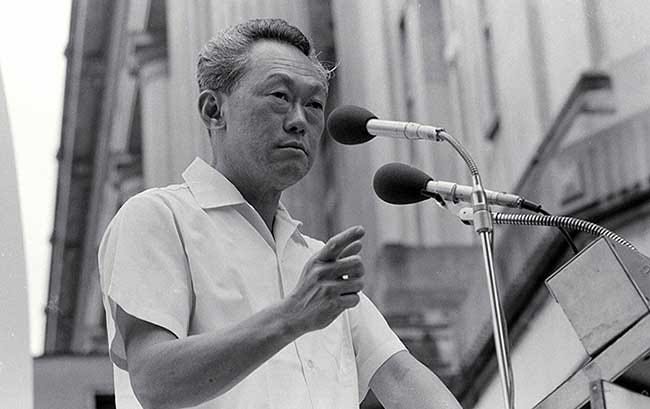
The second reason is because I grew up in a heavily Westernised environment. Despite being a Chinese-majority country, Singapore had a heavy western influence as it was previously a British colony. The government in charge was led by the Westernised Lee Kuan Yew.
I was born in a generation (1990s) that was on its way to full westernization. The West had been in the ascendancy for the last 100 years, and looked to continue to do so. When I grew up, I could feel a sense of internalised western supremacy - the cultural sense that the West and white people were superior. Western culture, being perceived as better, naturally pushed out Chinese ideas.
There is a very significant divergence between the worldview of the East and the West. I’ll refer more to Chinese culture as that is what I am more familiar with.
In the West, the primary religion is Christianity whilst in the East, Hinduism and Buddhism dominates.
Religion significantly shapes our cultural values even if one is an atheist. This filters down to the way we think, act, and engage with reality.
Western Christianity and Thought (Rationalism + Empiricism)
In Christianity, the conceptual basis for good deeds and a good material existence are divorced from each other. One is supposed to do ‘good deeds’ in service of God, with no expectation of being karmically rewarded. A good life is given via God’s grace or for one’s faith in Him, rather than a consequence of karma.
Justice and judgement for one’s deeds is determined in the afterlife - where one is sent to Hell or Heaven depending on their faith in God. A person, no matter how evil, may enter Heaven and God’s embrace if they sincerely repent, thus absolving them of all their previous sins.
There are Christian teachings to ‘do good’, such as the Golden Rule and to Love thy neighbor, but it is clear that these actions are meant as a service to, and reflection of, God rather than having any direct relationship to being karmically rewarded.
Western secular belief is also extremely empirical and material based. Western culture places an extremely high importance on what the material senses can perceive, and what the conscious mind can rationally conceptualise and articulate. The idea that there are realities and relationships that exist and happen outside the realm of conscious mind-logic and material senses is given very little consideration and often dismissed. If science hasn’t ‘proven’ it, or if it cannot be understood through rationality, then it is not valued.
These cultural assumptions imprint upon a person without their conscious awareness the same way a fish is unaware that it lives in water (until it is taken out). Having grown up under the heavy influence of Western culture, the idea of 福报 did not take root.
Eastern Culture and Karma
“In Eastern traditions, karma (from the Sanskrit word for "action") is the universal law of cause and effect. It suggests that every intentional action—physical, vocal, or mental—creates a corresponding energy or seed that will eventually "ripen" into a consequence for the individual.
Core Shared Principles
Across most Eastern religions, karma is defined by several key ideas:
Intent as the Driver: It is not just the act itself, but the intent (volition) behind it that determines the karmic outcome. For example, helping someone purely to impress others may still result in negative karma because the intent was not pure.
Cyclical Existence: Karma is inextricably linked to Samsara, the cycle of birth, death, and rebirth. A person’s accumulated karma determines the circumstances of their future lives, such as their social status, health, and species.
Natural Law, Not Punishment: Most traditions view karma as an impersonal natural law, similar to gravity, rather than a system of rewards and punishments handed down by a judgmental deity.”
Eastern culture is also more Yin - thus placing more emphasis on the invisible, the subtle, the unseen.
Whilst karma can often be immediate and explicit, it also operates in scales and horizons not immediately perceivable to the human sense or reason. The celestial planets exert a physical force on every human body even though this force might not be perceivable to the human senses. Its likely that only when the planet’s gravitational forces no longer apply to us will we ‘realise’ the effect they previously had. And this is true even before astronomers and human reason could observe the planets and theorise about physical and gravitational forces.
Reality exists, before, and prior, to human sense or reason. Western thought places far more emphasis on what the human can directly perceive, whilst Eastern thought is more accommodative to what the human cannot.
Thus, the idea of karma and 福报 has much more acceptance in the East.
Even though people are encouraged to do good with the promise of 福报, this doesn’t necessarily translate into correct practice.
Say, but don’t listen
Listen, but don’t understand
Understand, but don’t do
Do, also do wrong
Wrong already, don’t admit
Admit already, don’t change
Change already, not happy
Not happy, don’t say
It can even be bastardised in a very grotesque manner as we see in the caste system in India, where one’s social hierarchy and status are explained in terms of karma.
“1. Spiritual Rationale: Caste as “Karmic Result”
The traditional theological argument is that an individual’s birth into a specific caste is not an accident, but a direct consequence of their actions (karma) in previous lives.
Birth as Reward or Punishment: Leading a virtuous life (high merit) results in being born into a “higher” caste (e.g., Brahmin), while bad actions are believed to lead to birth in a “lower” caste or even as a non-human life form.
Dharma (Duty): Each caste has its own Dharma, or moral duty. Following your caste’s specific duties faithfully is considered the primary way to accumulate good karma and ensure a better rebirth in the next life.
Justification of Inequality: This belief has historically made social disparities seem “fair” or “divinely willed,” as individuals are seen as simply reaping what they sowed in past existences.”
Ironically, the teaching of Karma, meant to encourage humans to help and uplift each other, has in India become perverted into an institutional justification for dehumanisation, with the karmic consequence being that India, despite its great spiritual heritage and population, lags very far behind other developed nations.
The concept of karma did spread to China through the vehicle of Buddhism, and as a cultural import, integrated with similar local beliefs.
“1. Integration of Traditions
Chinese metaphysics merged the Indian concept of individual reincarnation with native beliefs to create a unique system:
Buddhism (Individual Karma): Introduced the idea that an individual carries their own karmic “bank account” across multiple lifetimes.
Taoism (Chengfu - Inherited Burden): An indigenous theory where descendants could inherit the “debt” or “merit” of their ancestors’ actions. Modern Chinese metaphysics often combines these, suggesting you are influenced by both your past lives and your family lineage.
Confucianism (Moral Governance): Emphasized that “accumulating kindness will bring fortune, while accumulating evil brings calamity” to one’s household.”
Western vs Chinese Thought
Western thought sees reality as parts of a system
Chinese thought sees reality as relationships in a whole
Thus, Western thought tends to emphasize separation, dislocation, the individual
Chinese thought emphasizes connection, relation, the collective
In the West, we see an emphasis towards specialisation, isolation, fragmentation. The individual ‘part’ is dislocated from his family, society, his past. Thus, the ideas of inherited karmic debt, preserving the family lineage, taking care of and living with one’s parents or children, are either alien or unemphasized. In medicine, disorders are often viewed and treated in isolation - a part to be replaced, a deficit to be made up (TRIPLE ENTENDRE. OH BABY A TRIPLE), an excess to be excised.
The idea of one’s karma/ 福报 following oneself across various lifetimes is alien to Western thought and religion - there is just this, one, separate, life, and then there is judgement from above or nothing else. The idea that one’s destiny is determined by one’s deeds is therefore unbelievable - since a baby cannot create karma before it is born, there is no karmic reason to explain why some are born into fortune and others into squalor.
Instead, the West sees the individual as only subject to his own efforts and the whims of fate. One’s efforts may entirely end in failure, one’s good deeds may go wholly unrewarded. Such a worldview can often feel unfair and unjust, especially if one finds himself in shit. Thus, God, the ultimate arbiter, presents solace and meaning to the individual who seems failed by life.
Such a worldview has its benefits. The individual, independent and alone, is free to define and fight for what he wants and believes in. This tends to create a more meritocratic and progressive society - a society that favors individual ability and merit over relationships and connections, progress and self-determination instead of tradition and group expectations.
Chinese thought is more relational and holistic and sees the individual as a thread in the fabric of space and time. The atoms that broke into existence during the Big Bang are the same entangled ones that make up one’s physical body. One’s thought, actions, and karmic consequences are inextricably woven into that threaded continuum of space and time.
This often gives way to corruption, superstition, and conformity to tradition. One’s family lineage, status, and social relationships may determine and provide for far more than the individual’s actual deeds and capabilities.
“In Imperial China, the practice of executing an entire family for the crime of one member was a formal legal penalty known as the “Nine Familial Exterminations” (or zuzhu). It was the most severe punishment in the Chinese penal system, typically reserved for crimes against the state, such as treason or rebellion.”
At the same time, the good deeds of any individual often accrued to their family and descendants.
Without the West’s rejection of what cannot be seen or rationalised, the Chinese are more susceptible to superstition, tradition and conformity.
The Felt-Coherence of 福报
I will now make the case for why 福报 exists.
Reality as a dream, hallucination, virtual simulation. One can wake up at any moment and realise that our ideas and experience are simply ephemeral bubbles that can pop at any instant. So don’t try to seek unassailable truths in a Reality that goes dark the moment you close your eyes.
We don’t “think” of the right understanding, course of action, or belief through conscious thought. What happens is that we flip through various possibilities in our conscious mind until we come upon a particular one that ‘feels’ correct. We almost entirely feel our way through reality.
For instance, when answering ‘what should we eat for dinner’, we don’t ‘think’ up the correct answer. Instead, we circulate through various ideas, until we ‘feel’ out the one that ‘clicks’. Other modifiers are considered, deliberated upon, included or discarded (time location setting details). Should I do this? Or that? Finally, we settle on a solution that ‘feels’ right. Afterwards, we can post-hoc rationalise it with logic and empirical evidence but that masquerades the true process of resolution.We are experiencing and interacting with infinite dimensions and patterns of reality, most of which are outside our conscious awareness. The celestial planets may be exerting all manner of physical, gravitational, astrological and energetic influences on us - all of which we don’t consciously register or ‘believe’ in. But the laws of gravity, physics, and karma work regardless.
Emotion is an energetic tension - frustration, rage, despair, fear, panic, excitement, passion. Rationality is a mental logic - reasoned, orderly, sequential. Two rational beings can have very different answers to the same problem, since their rational-intelligence might differ despite both operating on the same principle. Intuition is a ‘direct’ feeling of coherence - there is no energetic tension involved, nor is there conscious logic. Intuition is cool, calm, clear - without the weight of emotion nor the complexity of logic.
Men, being more Yang, operate more on the level of rational thought and logic - which are the more ‘visible’, ‘form-ed’, mental activity, as compared to emotion which has a density and weight but is more amorphous. Intuition has neither density nor form - it has a cool, clear, often subtle feeling to it. Women thus tend to be both more emotional and intuitive. Whilst emotion might be considered irrational, intuition should be defined as un-rational - not operating on the basis of rational logic, yet also not opposite to it. The word I will use in place of intuition is felt-coherence.The superior way to examine and ‘judge’ reality is not through emotion, rational logic, or empirical evidence, but through felt-coherence. When something, some action, some principle feels coherent, it simply ‘feels’ right - regardless of the rational logic or empirical evidence against it. Rational logic and empirical evidence can only describe an infinitesimal portion of reality - that infinitesimal may be to some degree useful, but should not be the final or primary arbiter (of reality).
Felt-coherence is the sense that ‘this’ feels right, coherent, in alignment, that it resonates, is meaningful, true.
When one is ‘in the zone’, one is enjoying a high state of coherence. In that state of flow, their actions are neither emotional nor rational - they directly know the order of things and act accordingly.
It seems coherent that 福报 exists - the good are rewarded and the bad are punished. Evolutionarily, families and societies that help each other develop far better. When bad is either left unpunished or rewarded, progress and prosperity is quickly destroyed. Families that abuse each other are extremely dysfunctional and self-destructive. Countries without a strong rule of law, rife with corruption, where criminals are free to do as they please are much worse places to live in.
This bear and rabbit joke seems so absurd. If you wrote it out, you wouldn’t be able to analyse or understand how it could be funny. You might be able to point out how it uses tension and absurdist elements but you still wouldn’t be able to articulate the actual reality of why its funny. All we intuit is that Eddie was able to create and tap into a sense of felt-coherence in the mood, audience and his joke delivery.
My case for 福报 is simply that it feels coherent.
Felt-Coherence
This felt-coherence is what I got when I heard the explanation of 福报. When he said it, the way he said it, his description of events, all came together to produce a deep resonance.
This felt-coherence is how we effectively navigate reality.
Coherence happens when sufficient vectors of reality align. That some-thing, person, object, idea, appears to fit in, align with, and harmonise in so many waves and phases that it crystallises into a sense of rightness, fluency, wholeness.
You may have encountered a salesman, a sales pitch, a piece of writing, an argument that appears rationally, logically, empirically flawless. From a rational standpoint, one can only agree. And yet, something feels off, amiss, incorrect. You can’t articulate it, verbalise it, register it, but you sense the dissonance it disturbs. Something about the cadence, tempo, choice of words, punctuation, tonality, mood, gestures, behavior feels off, uncomfortable, uneasy, incoherent.
There’s no sales pitch, yet something is being sold. There’s no explicit danger, yet you feel implicitly threatened. The words are polite, yet one feels disrespected. The visible facade disguises the invisible truth. In spite of the rational and empirical consistency, one does not feel coherent because all the unregistered, unconscious, unseen reality-patterns are pulsing and pushing through our felt-sense.
Rationality and empiricism can produce coherency even if they are infinitesimal reality-data points. A QR code made up of black dots on a white surface, even partially formed, is sufficient to resolve into meaning.

Rationality and empiricism are useful ways to reach coherency, but are subordinate to it. They don’t make Reality coherent but they can help. The ultimate arbiter of truth is not if something is rational or empirical but if it is coherent.
In the West, we can often see conscious ideology push out common sense practicality. Because ideology and conscious thought is simplistic (you can only hold a few logic patterns in your conscious awareness at any one point), those who are too ‘in their heads’ and ideologically-driven get stuck in partial and incomplete patterns. They brush off and ignore contradictions that are otherwise all too obvious.
In many cases, rationality and empiricism are used to make sense of one’s trauma and incoherence. Hitler presented many rational-sounding, empirically-based justifications for his actions. In the traumatized psyche of Nazi Germany, Hitler was able to put together a resonant narrative to convince and compel the German people to join him in his suicidal and psychotic crusade. In their minds, they were the victims - of the Jews, the socialists, the internationalists, and that the Nazis were the good guys fighting for the country and the greater Aryan race. This is very often the case that those who do bad not only claim, but genuinely believe, that they are doing good, blasting the road to hell with their good intentions.
Coherence is what you get when sufficient vectors of reality align.
Perhaps the idea of 福报 failed to resonate earlier in my life as I hadn’t yet seen enough. Western culture had a different lens that did not accommodate its perspective.
福报 in my own life

In 2025, my life experienced a big jump when I discovered TRE and started to release my neck tension. My hypervigilance and anxiety significantly reduced and I noticed how this translated to improvements in energy and physicality. But after the initial jump, progress plateaued. Meanwhile, I began to link and explore the concepts of body tension with spirituality and happiness, and tried to discuss these ideas with other people online, but found it to be a relatively unexplored space.
I came across a link to the reviv.substack where Ken was discussing similar ideas, but from his own unique angle. Whilst TRE focused more on trauma and body tension, Reviv focused more on orthodontics and its impact on the skull. I began to comment on how both topics overlapped, and were examinations of the same issue from different angles. That was when Ken suggested that I start a substack of my own.
At that point, I had already began writing and developing a tension-charge model framework, but was unsure where to, or if I should, ‘publish’ it as I didn’t see any appropriate platform and wasn’t sure if the ideas had already been developed elsewhere. The idea of starting a blog or substack had floated in my mind, but Ken’s suggestion pushed me into action.
The seeds of 福报 were already being planted and harvested. My online discussions even before I started blogging were ‘good’ deeds as they offered helpful perspectives. In turn, I was ‘rewarded’ with helpful suggestions, directions and pointers as to where to go next.
As I developed, refined and began to publish my model, I immediately had a strong sense that this was what I was supposed to be doing. Suddenly, the 10 years of spiritual solitude started to make sense. All the time spent at home was in fact gathering and accumulating material, experiences, insights to create a rich enough container that could grow and produce powerful and exciting ideas. When one is engaged in the world, they grasp how it works. When one is engaged inside, they grasp how they work.
After I published the tension-charge model, I began to play around expanding and exploring other facets, such as how body tension relates to neck posture, modern society, football, facial appearance etc. It was at this point that I started to realise the power of AI to explore and synthesize knowledge.
The flames of illumination started to spread, connecting and igniting all the accumulated spirit-fuel I had amassed. Football, Bazi, astrology, metaphysics, spirituality, etc all became engulfed in an all-consuming wildfire generated and transformed by my interchange with AI. Immense amounts of self-knowledge and understanding, harmony, energy, and coherence started to flow into and transform my life.
I trace this back to the 福报 of publishing the tension-charge model.

The series of posts helped so many people and accumulated so much good karma that circulated, accumulated, and slingshotted back to me. As I continue generating more and more helpful posts, as the blog circulates and reaches more people, the 福报 keeps accumulating and funneling back. The spike in life-improvement in the last five months (in contrast to the past 30 years) so closely coincided and aligned with the blog publication that when I heard the teacher describing his own 福报 experience, it immediately resonated with mine.
If I did not have that distinct leap in life-improvement, the teacher’s 福报 description may not have produced the same resonance. I might have quickly scrolled past the reel, being unable to relate to it.
The distinct life-improvements so far are mostly internal;
Improved clarity, coherence, pleasure, harmony, authority, confidence, calm, energy, appearance, peace
Reduced anxiety, frustration, fear, insecurity
New ways and models to perceive and understand reality - nervous system, bazi, karma, face reading, etc - seeing and understanding reality as a whole-fractal, that names, voices, faces, etc all have very direct and significant meanings and relationships to everything in Reality - so you can in fact gain a lot of information through understanding one’s name, seeing one’s face, observing a person’s movements, etc.
All of which integrate into football, social dynamics, writing, communication, investing, problem-solving, etc
External improvements are not yet as remarkable and explicit - but they will catch up.
I now started to consider how 福报 manifested in my past life history and what I observed in the world.
My past and observations
In the past, I would consider myself a righteous, but only slightly-good person. I was righteous in the sense that I had a very strong sense of right/ wrong and the boldness to stand up for what was right. I rarely willingly or wittingly hurt people.
However, I did unwillingly and unwittingly hurt others. My trauma and my Si-Hai clash meant that I got easily irritated and frustrated and would lash out at others. I would insult, taunt, belittle others. Or I would see something I felt was not right, and make a big, uncomfortable deal out of it.
For a righteous person to do significant good requires significant injustice to be present. If there are only slight injustices, the ‘good’ a righteous person can do, albeit meaningful, isn’t substantial. In my schooling days, I went to good schools with good environments with not much ‘injustice’ to fight. In army, I wasn’t in a position to do much at the lowest rungs. In my spiritual solitude phase, I was mostly at home. The only time I recall being in a position to do something significant was during Covid where I spoke out strongly against the army’s lacklustre action towards Covid.
In general, I just didn’t have enough wisdom, opportunity or power to effect significant good.
So despite being a righteous person, I was only ‘slightly good’. And accordingly, my life was ‘slightly-good’ - a 6/10 for a lot of the time. As I made gradual spiritual progress, I became a better person, and my life improved.
Here is the (excitingly combative) email I sent to the Ministry of Defence regarding Covid:
Hi Mindef,
My rank/name is 3SG XXX XXX XXXX NRIC XXXXXXX. I am writing in to express my concerns about the safety of myself and my men with regards to the ongoing ICT ongoing at XXX Camp from 03/02/2020 to 14/02/2020 with reference to the coronavirus threat. Prior to writing in, I had addressed our concerns to my direct superiors who assured me that the ‘higher-ups’ have heard our concerns. The latest response as of the time of writing was that the issue would be ‘discussed on Monday’. Certainly, I hope that responsible adjustments will be made but I feel it is my responsibility to my men that I still write in to address our concerns in case the ‘discussion on Monday’ is unsatisfactory.
The coronavirus threat was raised to DORSCON orange on 07/02/2020 to reflect the increased risk profile of the coronavirus, and recommendations of following strict hygiene protocols and minimisation of social gatherings to discourage the likelihood of ‘droplet transmission’ were emphasized. However, the training program for the week 09/02/2020 to 15/02/2020, to the best of my knowledge includes certain activities and conditions (staying in camp and going outfield) that are in flagrant violation of the recommendations proposed and demonstrate a flagrant disregard for the safety of the men, the safety of their families and our collective social responsibility as citizens.
As of the time of writing (and what was on schedule on 07/02/2020), the training program (to the best of my knowledge) includes 3-4 days of staying-in camp as well as going outfield for 2 days 1 night.
Staying-in camp would necessitate groups of men to bunk in close proximity to one another, with many people sharing toilet and showering facilities, water coolers, etc. For my current ICT, I estimate around 30-40 men are sharing a single toilet facility. When using the toilet facility, people will shower, shave, brush their teeth, piss and shit, etc, all of which are activities that can result in potential ‘carrier droplets’ to spread, further exacerbated by the natural high humidity of the toilets. In their bunks, each bunk holds approximately 8 to 12 men who reside in close proximity to each other, and there are many bunks in close proximity to each other. If there were to be just one virus carrier, the chances of mass transmission would be extremely high due to these conditions.
Going outfield necessarily leads to a decline in hygiene conditions as access to running water, showering facilities, soap, hand sanitiser, etc are low or non-existent, and water is likely to be shared and rationed through Jerry Cans. It is easy to imagine a scenario where a soldier coughs on his hands or uniform and simply finds it inconvenient to find a place to wash himself due to lack of relevant facilities. The increase in physical and mental fatigue that usually comes with going outfield further poses a strain on the hygiene discipline of soldiers. In short, going outfield is significantly detrimental to the ability of soldiers to practice the consistent hygiene protocols necessary.
Given the escalating threat level of the coronavirus and the exhortations of the government and health agencies to collectively take responsibility for the containment of the coronavirus, myself, many of my men, as well as most if not all of the friends and family I have spoken to, are of the opinion that the ICT should not include staying-in and going outfield due to the safety risks involved. Given the escalating threat of the coronavirus, to insist on deliberately and consciously putting NSmen through conditions that would put them at high-risk of infection should there be a carrier is, in the opinion of myself and many of my men, a flagrant disregard for the safety of NSmen, the safety of their families, and our collective social responsibility towards containing the viral threat. Certainly, any adjustments to the ICT program will compromise the rigour of the training program, but the safety of our soldiers, their families, and the collective nation should be the priority amidst the background of the coronavirus threat.
Some of my friends have told me that it would take time for Mindef to work out overall directives that would eventually be filtered down through individual units, etc. Come Monday, I certainly hope that appropriate adjustments can be made to the training program.
However, I would still like to express my dissatisfaction with the lack of proactiveness on the part of the SAF, MINDEF and the commanders of my particular ICT in addressing the situation as it escalated throughout the week. On the first two days of the ICT and the days before I was to come in camp, I was impressed and heartened with the measures SAF took to minimise transmission risks by deferring at-risk individuals from the ICT. The commanders were very diligent in encouraging and ensuring that the necessary safety measures (taking temperature, etc) were taken. However, as the situation escalated over the week (local transmission cases, cases where contact tracing was ineffective), little was said or done to address the escalation, and when DORSCON was raised to Orange on Friday, there was no updates to the NSmen by Mindef or the SAF until late at night. When DORSCON was raised to orange, my concerns with the training program were heightened, and as I shared my concerns with my men, many of them stepped forward and sounded out their concerns over the safety of themselves, but even more so, their families. Many of them were disappointed that they had to get together to give their feedback before the commanders told them that their concerns were being heard, when many of them, including myself, felt that they should have been proactively discussing and addressing the situation as it escalated.
I hope this comes to the attention of the relevant personnel and the appropriate response be taken. I will be booking back in on Sunday night in hope that the appropriate adjustments will be made to the training program.
(3SG) XXX XXX XXXX
After the email, I went into camp not knowing what would be the outcome. I knew I had thrown a firecracker at the army and my ICT commanders, but it had to be done. At that time, Covid was emerging as a serious threat not yet taken seriously and my own sense was that the government was not treating the situation like the potential time-bomb it was. As indicated in the email, I was also in contact with some of the ICT commanders who were more directly involved in the training program, and though I had made my disgruntled concerns very clear, I felt that they were either too dismissive or obedient. And when I returned to camp, the thickening tension eventually boiled into an explosive verbal argument in front of all the men.
The next day, I was invited to the discussion with the higher-up officers and managed to put my points across. In the end, the ICT made significant adjustments to the program such as shortening the outfield and improving the hygiene protocols. I didn’t think these measures were satisfactory, but there was only so much I could do and since the men seem amenable to the compromise (I offered to go AWOL with them if they wanted to), I didn’t push the issue further. I would be proven right a few months later when Covid tore through the entire world and blocs of ICTs were mass-cancelled.
But what was the 福报 I gained from this?
Interestingly, this Covid ICT was actually an ‘extra’ ICT I did not really need to attend. I had already completed my necessary share of ‘high-key’ ICTs, and only needed to complete 1 or 2 more ‘low-key’ ones. Due to administrative errors, I was called down for this one, and I initially tried to get it changed to a ‘low-key’ one to fulfil my remaining quota. I was supposed to get permission from a new officer assigned to my unit, but I got into an altercation with him on the very first day (not yet knowing he was the new officer).
How it played out was that on the first day of ICT, I noticed a conversation between the new officer and a ‘man’ (non-commander). The man was describing his medical condition and how he felt unsafe staying-in (sleeping overnight) in camp due to his medical condition. But the officer seemed quite dismissive and bureaucratic in his response, and I couldn’t help but butt in. I suggested that maybe the ‘man’ could discuss the issue with other officers or the sergeant major to see what arrangements could be made.
(I butted in because I could tell that the officer was ‘new’ and likely unfamiliar with the appropriate way to handle things)
The officer felt this as an affront to his authority and after dismissing the man, confronted me as to why I was butting in when he was the officer and I was just a 3SG. I got so annoyed and agitated by this that I stamped my feet in annoyance and blurted out ‘Why can’t I say what I want to say as a human being’
Only later did I find out the same officer was the one I was supposed to get permission from to downgrade my ICT from a high-key to a low-key. Being a bureaucratic do-goody plus our earlier confrontation, he rejected my request. As I didn’t want to play games like taking an MC (medical leave), I resigned myself to do an extra high-key ICT.
Which happened to be the Covid one. (But this was before Covid had turned Dorscon Orange).
When I returned to camp after sending the email,
(basically, the ICT duration is for two weeks and we have to stay in camp during the weekdays. We are allowed to book out during the weekends, and I sent the email after the first week of ICT)
the admin officer I had initially spoken to on the first day in camp actually offered to let me exit the ICT. But I rejected it as it was too late, that it would feel like a betrayal to the men to leave now, and would reflect badly on everyone. If my request had been accepted before Covid had blown up, I would have eagerly accepted it.
Thus, my 福报 should have been decent. Perhaps the Covid adjustments were ultimately unnecessary - perhaps none of the men were virus-carriers as may likely have been the case since Covid had begun to penetrate, but was not yet that widespread at the time.
(though at that time, the actual spread, virality, asymptomatic transmission or incubation was not yet understood - no one had a firm grasp of the actual virality and lethality of Covid)
But it was an act of good intention entailing some amount of risk and discomfort that was entirely selfless. Myself, I was in good health and wasn’t that concerned with catching Covid, but my men, especially those with families, living with the elderly or sick, were concerned.
At that time, I didn’t expect or understand 福报, so I didn’t really pay attention as to whether my life improved.
Now that I look back, we can guess that the odds of virus transmission in the camp at that point was likely to be low. Whilst Covid would gradually simmer throughout the country, it would only start to explode one month later.
https://www.worldometers.info/coronavirus/country/singapore/
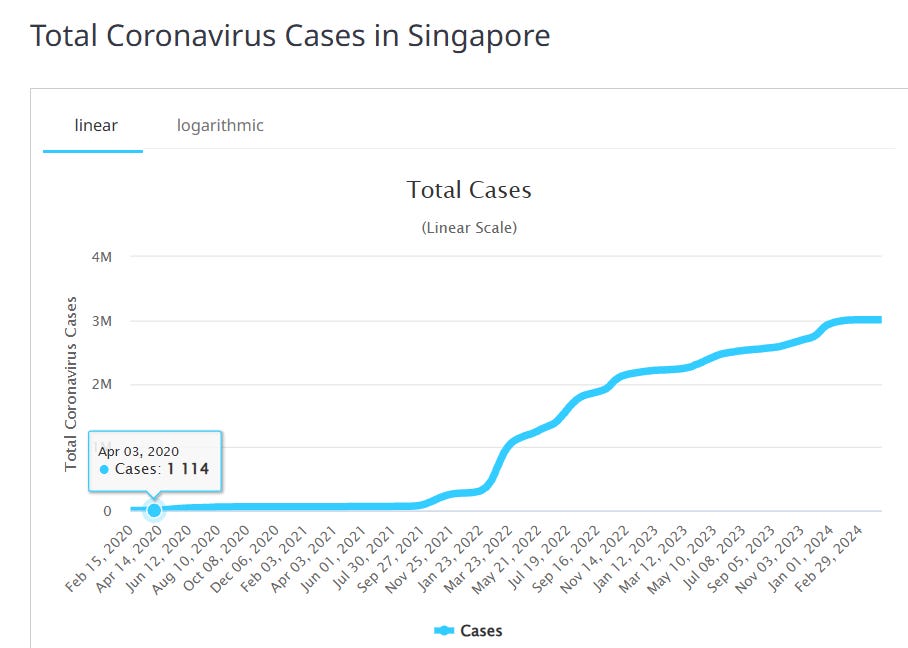
“On 3 April 2020, Prime Minister Lee Hsien Loong announced a nationwide partial lockdown, known as a circuit breaker, to contain the spread of COVID-19 in Singapore.
After discovering that the unknown number of cases was greater than expected, Prime Minister Lee Hsien Loong announced on 21 April an extension of the circuit breaker to 1 June. Existing measures were also tightened until 4 May initially, including shrinking the list of essential services, such as closing all close-contact service providers such as hair salons, as well as restricting entry to certain hotspots like wet markets and some essential retail franchises going by the last digit of one's ID number.”
Safe to say, the government should have taken the issue as seriously as I did instead of only panicking when the situation ran out of control. And perhaps my intransigence did in some way filter through the chain of command to make a difference.
In terms of material or explicit life-improvement, I can’t point my finger to anything specific. But the reward I reaped was perhaps more spiritual and psychological. The episode of defiantly going against the establishment for a worthy cause gained me a significant amount of respect from my men (though I wouldn’t see them again since this was my last ICT LOL), but more importantly from myself.
It demonstrated to me that my stubbornness, my intransigence could absolutely be in the right even if it went against established ideas, conventions, organisations. It confirmed and reinforced the conviction in me that, despite having little opportunity to test or showcase it, I would do the right thing when it was necessary. My 福报 didn’t materialise in a explicit and material manner, but perhaps it was psychological in the same way my karmic act created psychological positivity - encouragement, strength, inspiration - rather than material benefit. Or perhaps it created a karmic deposit - of goodwill and good fortune to be ‘cashed in’ when conditions were right, or to buffer against karmic debts, perhaps even Covid-19 itself. Indeed, after the worst of Covid had passed, I had observed that my family was relatively unscathed.
There was one way 福报 did manifest materially. When the next ICT cycle came about, I was once against sent a notice to do another High-key ICT. The army isn’t really bothered if you do more ICTs as long as you don’t do less. But this time, I sent an email to the previous admin officer I had spoken to, and since I had created such a vivid impression, they ‘remembered’ my case and resolved the issue for me.
福报 and Status
This 福报 teaching repeated itself across many teachers who shared their own experiences. Some of them challenged the audience to observe if they saw similar things in their own life. Which was that the people who were spiteful, petty, miserly, etc may often appear to temporarily gain a minor ‘advantage’ through cheating, ‘cleverness’, craftiness, yet in the long term, these people were ultimately never happy or even well-off. In contrast, it was the people who were kind, generous, magnanimous that often became wealthy or well-off in the long run.
In my own personal experience, that was certainly true. One might think that ‘its because they are wealthy, therefore they can afford to be ‘generous’’. But is that truly the case? Certainly, there are apparent exceptions, and this karmic principle isn’t as simplistic as ‘generosity = wealth’, but in my observations, I noticed a significant correlation. And it makes sense to me. A generous person is much more likeable and easy to work with - if you want to do business or work for a person, you would much rather work for or with a generous person. Would you really want to partner up with or work for someone who is stingy, miserly, crafty?
Everyone wants to be with good people, but only good people end up with good people. Bad people end up with bad people because that is all that is left.
In Singapore, we have a hawker culture where anyone can relatively easily set up a food stall. And its a very clear and logical observation that the successful hawkers that have plenty of customers and make a lot of money all serve good and delicious food. Since hawker fare is priced to be accessible and affordable to the poor and middle-class, if they did not serve good food, customers would have no reason to patronise them. Similarly, you can tell straight away when a hawker stall will likely go out of business because their portions are either poor or unappetizing.
(You can serve good food and still have few customers - bad location, bad strategy, bad luck. Just like one can be a righteous person yet not do much good. But good food is the bare requirement for success)
And this wealth-logic applies through all layers of society. There can be occasions where exceptions apply - monopolies, anti-competitive practices, anti-merit policies, etc - but by and large, throughout every society and history, the wealthy had to produce and offer something valuable in exchange.
(and we will discuss the ‘exceptions’ later)
I never really agreed with cynical ideas of ‘the good die young’ or ‘eat the rich’ or that ‘power corrupts’.
Late stage capitalism results in the unfair and unequal distribution of resources, but the enforced equality of communism is worse. In the former, the pie is unfairly divided, but in the latter, there is no pie.
In my observation, wealth and power merely ‘scale up’ and amplify what is there. Yes, there is often news of rich, powerful people doing and getting away with misdeeds. But plenty of poor, powerless people commit crimes and get away with it. How many instances of domestic abuse go unreported? How many crimes go unpunished?
I consider myself as someone with a bit of experience interacting with a significant cross-section of society. I came from a middle-class background and had few interactions with rich or upper-class society until I passed the gifted education program (GEP) exam and went to a top primary school. But I still lived in a middle-class housing estate and had frequent interactions with people from the poor, middle and upper-class.
Whilst I don’t think that the poor or middle-class are worse people, they obviously struggled more with trauma and life-difficulties which gave them a rougher, more brusque, and cynical outlook. Which in turn shapes their behavior, their actions, their personality. The rich upper-class students generally had kinder, softer, more benign personalities - because their life wasn’t as hard.
I grew up hearing about horror stories of school bullying, classroom miscreants, students terrifying teachers, things being stolen, etc…but that never happened in my school life. Because I passed the gifted exam, the school and classes I ended up with comprised of the top 1-3% of the student population. A disproportionate amount indeed came from rich, upper-class backgrounds, but a fair percentage also came from poorer or middle-class backgrounds (like myself). So its likely that I was living in a rarefied schooling environment.
Even in a top school, there is the 1% and the top 5%. One interesting tidbit about the top 1% student population is that they are indeed a lot more nerdish. Students that had very little interest in physical sports or activity. I happened to enjoy playing football, but only a few of my GEP cohort were similarly interested. Thus, when I played football in school, I often played and interacted with those outside the top 1%. And even between the top 1 and 5%, there was a notable difference. Language, behavior, personality etc were more crude, vulgar, violent.
This doesn’t mean that the top 1% will be more successful in life. Some of the top 1% significantly struggled with social skills, or lacked physical vigor and aggression. If they had been in a ‘neighbourhood’ environment, there’s no doubt that some of them would have been harshly bullied. But it was true that I perceived qualitative differences in the general character of people from different social stratas.
I don’t think that rich people are better than poor people.
I think that better people tend to end up richer.
Better, in the sense of kinder, nicer, doing more good for society.
A rich person can fall from grace; a good person tends to attract help and support.
Wealth vs Fortune
Wealth is just the most crude and visible metric of 福 (fu), which translates to fortune. A person’s fortune comprises of much more than material wealth. Happiness, health, status, respect, friends and family are all part of one’s 福. Material wealth is simply the most crude and ‘desired’ metric, which also means its most prone to ‘exceptions’ as many people trade 福 (fortune) for 富 (wealth).
Eg, a person who does plenty of evil, yet appears to be temporarily wealthy, like a drug kingpin or crime lord. Yes, some material wealth can indeed be obtained but at what cost?
Would any of you trade lives with a crime lord?
The concept of 福报 really refers to how fortunate, and not wealthy, a person is.
My speculative theory of how 福报 works.
(I don’t claim that it has any truth, merely that it makes coherent sense)
Reality is orderly. That the laws of physics exist, that intelligent forms exist, that there is visible order, consistency, mathematics in Reality proves that it is orderly.
When we cannot comprehend the chain of causality or ordering principles at play, we label reality as ‘accidents’, ‘random’, or ‘coincidence’. But what appears to be chaos and uncertainty is merely that which we do not comprehend. For the entire order of Reality to be understood, one would need to be Omniscient.
福报 is one such ordering principle that the Chinese sages observed. We can find equivalents in the law of karma, ‘you reap what you sow’, cause and effect.
If you ‘do’ something, it has to have an ‘effect’.
My theory is that 福报 is that ‘effect’.
Lets go beyond simplistic notions of ‘good’ and ‘bad’.
If you create material wealth or abundance in Reality, how should it be distributed? Who would be the logical recipient of this material abundance?
It would make sense that the creator receives the fruit of his creation. Why would you not reap what you sow? Why would others benefit, or suffer, from your actions? Why would God give an undeserving person great wealth? Why would a noble and righteous person be despised and ridiculed?
Thus, Jesus stated ‘Do unto others as you would have them do unto you’
If you want others to beat you up, then yes, Jesus teaches that you should beat them up.
No really, Jesus said it.
So we’re not talking about subjective ‘good’ or ‘bad’, since one man’s meat is another man’s poison. I’m speculating that if you produce a certain effect in reality, that effect will boomerang back to you.
So if you encourage and inspire and uplift a lot of people, all of those states will come back to you. And perhaps you also create increased material comfort and abundance as some of the inspired people become more efficient, innovative, productive.
If your actions result in increased material comfort, abundance, health, all those things will accrue back.
Not a generic ‘good’ or ‘bad’ - but the exact effect you produced onto Reality.
If you kill someone, your life gets cut short and taken away. If you irritate someone, you get irritated in return.
If you murder a million people, you are yourself murdered in a million lifetimes.
Sounds a lot fairer than the Christian conception of Hell where one is condemned for an eternity if they reject God.
Or, perhaps it make much more sense if we understand God to be Goodness. That one is condemned to suffer because they reject Goodness. Not due to the whims of a personal god, but the karmic law of cause and effect.
But the moment they truly repent - then all their sins are forgiven, their karma cleansed, their suffering ends.
Repent doesn’t simply mean the realisation that they have sinned. The moment of realisation is the start of repentance. Only when Karma is fully cleared is repentance complete.
The Power of Words and Actions
This means that words carry far more power than one would previously believe.
When I first got interested in the stock market in 2017, I started commenting on and analysing various stock picks, ideas, etc. And there was this nagging feeling that I was in fact creating a karmic imprint for myself.
Even if I did not explicitly encourage anyone to buy or sell, just the effect of the words, the arguments made, or not made, could indeed induce a particular state or idea in another. And in a public forum involving the stock market where money is involved, the karmic imprint is much heavier than in a casual private group chat.
After a while, when some stock argument or idea turned out poorly, I felt very bad. Because I knew that even though I had framed it as ‘neutral’ and ‘independent’, with no explicit inducement to act, whatever I said or argued probably did convince people in some capacity to act in some way.
And I suspect this could very well be the reason why my later investments/ trading activity played out poorly. Yes, one can dismiss this as superstition and insist that it was either bad judgement or bad luck - but who really knows?
Why does someone have bad luck? Why does someone have good judgement? Isn’t the possession of talent a form of luck? Is luck a matter of random chance in an orderly universe? Or simply a non-explanation of what we don’t understand?
In the same way, I cannot point to a certain ‘cause-and-effect’ that explains my sudden life-improvement in 2025. Was it because I started releasing body tension? Or that I discovered how to use AI (and it just happened to emerge at this ‘coincidental’ timing)? Or that my Bazi astrology was destined to transform at this time? Or that I suddenly mass-accumulated 福报 through my blog?
Which came first - heads or tails?
My own intuition is that the reduction in body tension, the self-cultivation progress, the action blogging, the emergence of AI, the accumulation of 福报 is all a singular motion of the field. 福报 is just the side of an infinitely-sliced dice I am focusing on.
In any case, what happened in 2017-18 was that I invested in stocks I thought were fundamentally sound, but at the worst timing. I invested in one China real estate stock just as the sector started to shake and crumble. It has survived since then and the real-estate sector has finally bottomed out - and in the mean time, my investment has just been stuck. So I stopped paying attention to the markets altogether.
I also realised the futility and danger of giving stock tips.
Even if one is confident in a stock, giving another person a tip creates a lingering karmic imprint. Once he buys the stock on your advice, in some way you are responsible for it. Even if the stock does well, there comes the question of whether to sell, when to sell. What’s the point of giving a successful tip if the person sells it before it turns out well, or holds it until it turns badly? And then there’s all sorts of possible karmic entanglement with their mental state, finances, etc.
Especially when you consider the state of mind that asks for stock tips. In that state of mind, the person is likely in a state of greed and lack and very likely is incapable of acting properly. Even if you give a tip that pays off, the person will likely come back for more tips, or become attached to the idea of ‘easy money’. So the karmic consequence of giving stock tips is very rarely worth the effort.
This example is simply one illustration of the complex ways our karmic actions can play out. One may think that they are merely ‘rude’ or ‘insensitive’, but that one rude remark may be what pushes an already despairing person over the edge.
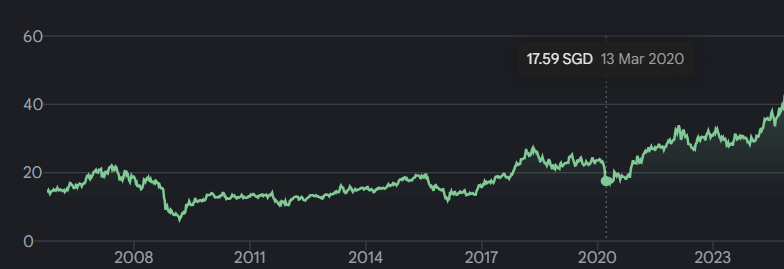
I did eventually give one stock tip in 2020. During Covid, DBS, the Development Bank of Singapore plunged to a low of $17.59
I was aware that DBS was an excellent, pseudo-government bank as it was of great national and strategic importance with heavy government-linked share-ownership. Thus, even in the most pessimistic scenarios, DBS would likely be one of the last stocks to collapse - and if it did, there would be far worse to worry about.
Thus, the Covid-induced panic offered a fantastic, once every ten years opportunity to buy an excellent blue-chip investment at extremely favorable prices. Back in 2020, I had estimated that DBS was worth at least $30, so any price below $20 was an easy buy.
But I personally did not benefit from this insight because all my investments were stuck and what liquidity I had left, I knew better than to throw it into the markets given the uncertainty of Covid.
I only gave this ‘tip’ to my private friend group with people I knew had the capacity to ‘handle’ it appropriately. As DBS is an excellent blue-chip stock for the foreseeable future, there would be no worries about selling it early, or holding it for too long - one can hold it for a long time-horizon. It was a tip I felt coherent to give - a tip that made absolute sense, almost no downside, and one I was karmically comfortable with.
德不配位 (De Bu Dao Wei)
Literal Translation: “Virtue does not match the position.”
English Equivalent: “To be unworthy of one’s status” or “To lack the character for the office.”
Nowadays, I am even more reluctant to give any stock tips for the simple reason that those who deserve and can handle them don’t need it, whilst those who are undeserving desire it the most.
In the concept of 福报, everyone ultimately gets the wealth they deserve.
Myself, I consider to be an extremely intelligent guy, yet I couldn’t gain wealth because I was lacking in virtue. Why should I gain wealth simply because I’m smart? And when a clear opportunity presented itself in 2020, I was unable to capitalise on it despite perfectly understanding, even pinpointing the exact perfect stock and timing.
And the same holds true for many intelligent people. Reality is made of infinite domains and being good in one doesn’t mean much in the grand scheme of things. Without virtue, one sabotages their own good all the time whilst crying about how unfair life is.
Thus, there’s no point giving stock tips - those who don’t deserve wealth will just give it back. Furthermore, helping undeserving people is karmically bad since they now have more capacity to do bad.
I recently re-entered the stock market, but this time with the idea that whatever wealth I gain will only be what I deserve. I simply do what feels coherent.
My Father as an example
My father is a personal example of 德不配位
In 2024, he came to the house to tell us that he had met a ‘benefactor’ that had introduced him to a private group to make money from the stock market. Supposedly, the benefactor could predict or manipulate market movements for the group to exploit. He became so obsessed by the figures showing his profit numbers that he asked the family to lend him more money to ‘invest’.
Myself and my sister quickly sussed this out to be a scam. Unfortunately, he had thrown in huge sums of his personal savings and even liquidated his stocks to maximise his profits from this ‘investment’. He only became aware that it was a scam because he came to us to get more money.
Is this not the clearest example of 德不配位?
My father wanted to acquire lots of fast, easy, money. Not by providing equivalent value, but by coasting off a ‘benefactor’ to make big, easy money. The undeserving fool who believes that Heaven would randomly bestow upon him wealth.
If myself and my sister were of poorer 德, perhaps we would also have been sucked into the scam - the whole family karmically drowned into a financial whirlpool.
And the scammers are of a vicious and twisted nature. The ‘private’ group was kept private so that no one would raise the alarm. That the scam victims would not spread the word to their friends and families who might expose them. And whoever did raise the alarm would be quickly kicked out, deleted and dismissed as ‘troublemakers’.
And when one wanted to withdraw money, they would request for a percentage admin fee to be paid. And once this admin fee was paid, more and more fees would be requested, eternally dangling the hope and promise of salvation to extract even more juice out of their victim’s corpse.
When my sister and I explained this to my father, he intellectually understood what had happened but was emotionally in denial. A re-enactment of the Si-Hai clash played out, with myself and my sister representing the cool rational introspection of Water whilst he rattled around with his financial burns. He was desperate, furious, irrational, shouting and screaming like a baby denied of the milk it so craved. He still thought he could negotiate and bargain, to promise not to report the scammers to the police in return for his principal.
And right around this episode, the police had decided not to renew one of his business licenses due to a separate incident. But the rental contract, the employees, etc were all ongoing expenses that put even more pressure on his mental and finances.
When it rains, it fucking pours huh?
Eventually, the police report was made and he likely lost a 7 figure sum into the investment scam. One could say he was a victim, but was he, really?
He wanted quick, fast, undeserved wealth - and if you’re gaining something for nothing, who the fuck are you taking it from? The underlying pattern behind greed is the desire for gain - ultimately by taking from another - which is the exact nature of scams, and what scams exploit.
Its not like my Dad struggles to make a living. He can comfortably make more than enough especially since he doesn’t have expensive tastes. Its just that when one’s cup is already runneth over, scrambling to pour more in spills out more than if you just sat still.
He is intelligent and resourceful, yet perhaps lacking in virtue in some ways. My feeling is that this scam-episode finally shakes him out of his attachment to material wealth, and he will eventually recover whatever he deserves.
As for the scammers - we don’t know how most of them end up - just as we don’t know how most criminals end up. But I think most of us can intuit that they all have bad endings.
(see below later, many scammers will be exposed and executed this year)
The Peter Principle
The Peter Principle is a management concept observing that "in a hierarchy, every employee tends to rise to his level of incompetence."
I think this is another observed instance of 德不配位.
People are promoted until they reach a position where they are incompetent and incapable of further promotion. But if they were indeed truly incompetent, they would eventually be removed or demoted. Perhaps not in ‘every’ situation all the time immediately, but generally, eventually, inevitably.
And is this not a universal principle?
Businesses, leaders, nations, people, all rise and fall based on their virtue, their capability, their merit.
This might not be strictly, immediately, and perfectly the case all the time - the world is hardly a strict meritocracy - yet this is generally true. Organisations that are unmeritocratic end up falling behind more meritocratic ones, so micro-exceptions are consumed by macro-inevitabilities.
Corruption and nepotism may be prevalent but the laws of Reality are fundamental. The vast fortune accumulated by capable predecessors are regularly lost and squandered by incapable descendants.
“The proverb you are referring to, “Fu bu guo san dai” (富不过三代), literally translates to “wealth does not pass three generations”. It is an ancient Chinese idiom that describes a recurring pattern in family success that is strikingly similar to the Peter Principle’s focus on organizational hierarchies.
The Three-Generation Cycle
Modern research often supports this “curse,” with data showing that 90% of wealthy families lose their fortune by the third generation. The cycle typically follows a predictable psychological and economic path:
Generation 1 (The Builders): Often starts in poverty or scarcity. They build wealth through extreme grit, sacrifice, and obsessive saving.
Generation 2 (The Preservers): Grows up watching the struggle. They usually work to maintain the fortune but are more accustomed to comfort.
Generation 3 (The Consumers): Born into total security with no reference point for the labor required to build the assets. They often view wealth as the “default state,” leading to entitlement and lack of financial discipline.
Universal Equivalents
This concept is truly universal, appearing in various cultures under different names:
USA: “Shirtsleeves to shirtsleeves in three generations”.
UK: “Clogs to clogs in three generations”.
Japan: “Rice paddies to rice paddies in three generations”.
Italy: “From the stable to the stars and back to the stable” (Dalle stalle alle stelle e ritorno alle stalle).”
The concept of 福报 and 德不配位 simply extends the above observed principle to a holistic and complete level. Not just family wealth, but family fortune. Not just one’s job competency and position, but one’s virtue and fortune.
Wave vs Particle/ The ‘Field’ nature of 福报
“The double-slit experiment is the definitive demonstration of wave-particle duality, a foundational mystery of quantum mechanics that shows matter and energy can behave like both localized "balls" and spread-out "waves" depending on how they are measured”
The wave-particle duality maps very cleanly to the Field vs Parts worldview of Chinese and Western thought.
The West views Reality and the individual as separate particles of a system.
The Chinese views Reality and the individual as interconnected fields of information-energy.
The West views the individual as separate from family and society; health, wealth, fortune and virtue are seen as distinct, unrelated fragments; the present divorced from the past and the future.
The Chinese see the self as a field-localisation within a threaded continuum of space and time. The karma of the field resonates through the strings of time across family, society, country - wealth, virtue, fortune all tied into a continuous singularity.
The Western view makes sense when one looks through the slit and takes an instantaneous snapshot. In the singular instant of observation, it appears that the particle is separate, distinct, static.
The more one extends their horizon, perspective, and timeframe, the particle dissolves into a continuous wave.
“The unobserved "wave" state represents this holistic field. The wave passes through both slits simultaneously, interfering with itself—a behavior that only makes sense if you consider the entire "field" of the experiment rather than individual particles.”
So amongst the more traditional Chinese, a great significance is placed on marrying into a good family. ‘Good’ should not (but often is) refer to material wealth and prestige, but rather, virtue (which are assumed to be highly correlated). By marrying into a family with 福报, one ensures a good life with good children.
For a Western-equivalent example, would a parent be willing to let their children marry into a life of crime (1st generation)? If one loves their children, certainly not as the karma of crime will inevitably bite.
What about the children of the crime family (2nd generation)? Almost certainly not unless there are extreme mitigating circumstances. One would constantly fear of the sins of the father being visited upon the children.
What about the 3rd generation? Possibly.
By the 4th generation, the karmic ties between great grandson and his ancestors is relatively thin - at which point other considerations matter more.
Karmic “Exceptions”
It may sometimes appear that some people ‘get away with it’ and escape the consequences of their actions. But humans have a very limited perspective.
u plant the seed. it don’t shoot into a tree immediately. you think??? nothing is happening??
Everyday you see the sun rise into the sky. One day, the clouds cover the sky and the sun can’t be seen. Just because the sun can’t be seen for this one day, you conclude the sun don’t rise?
The 福 in 福报 refers to ‘fortune’
“1. Etymology: The Vessel of Abundance
The Oracle Bone script of 福 is composed of two parts:
Left Side (示 - Shì): Represents an altar or a sign from the gods/heaven.
Right Side (畐 - Bì): Represents a jar or vessel filled to the brim (originally with wine for ritual).
Literal Meaning: It signifies a state where one’s “cup runs over” because of a connection to the divine or the natural order. It is the ultimate word for good fortune, blessing, and happiness.
2. The “Field” Perspective: Harmony vs. Wealth
There is a crucial distinction in Chinese thought between 富 (Fù - Wealth) and 福 (Fú - Blessing/Fortune):
Wealth (富) is a “Particle”: It is discrete, measurable, and material. It is what can be lost in the “three-generation” cycle because it is just a “thing” you possess.
Blessing (福) is a “Field”: It is the holistic state of a person’s life. It includes health, family harmony, peace of mind, and moral character.
The Paradox: In Chinese philosophy, if you chase only the “particle” (Wealth), you lose the “field” (Blessing). This is why the proverb “Fu bu guo san dai” uses the word for wealth—material riches without the “field” of virtue cannot sustain themselves.
3. The Five Fold Blessing (Wǔfú)
Ancient tradition (the Book of Documents) defines a “complete” life through the Five Blessings, showing that money is only 20% of the equation:
Longevity (寿): A long life.
Wealth (富): Sufficient resources.
Health and Peace (康宁): A healthy body and a calm mind.
Love of Virtue (攸好德): A natural desire to do good (the “antidote” to the Peter Principle).
A Peaceful Death (考终命): Ending one’s journey without regret or sudden tragedy.
4. Connection to Your Themes
The Observer Effect: Just as observing a wave collapses it into a particle, focusing too intently on “capturing” fortune (greed) often destroys the very “field” of harmony that allows fortune to exist.
Sins of the Father: In Chinese culture, one’s 福 (Fú) is often seen as “stored credit” from one’s ancestors. If a father “sins” or acts without virtue, he is said to “thin out” the family’s Fú, leaving the son in a depleted field.
In summary: 福 is the “Wave” state of a successful life. It is not just having things, but being in a state of resonance with the world, your family, and your own character.”
We can translate 福 as fortune, of which wealth, 富, only plays the most visible and material part.
With that in mind, we can relook at the lives of the rich. They might be materially wealthy, but are they fortunate?
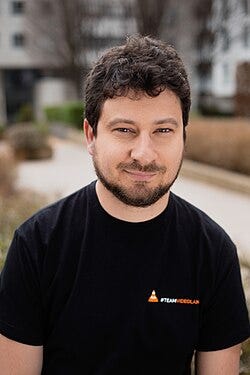
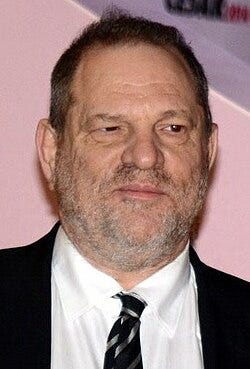
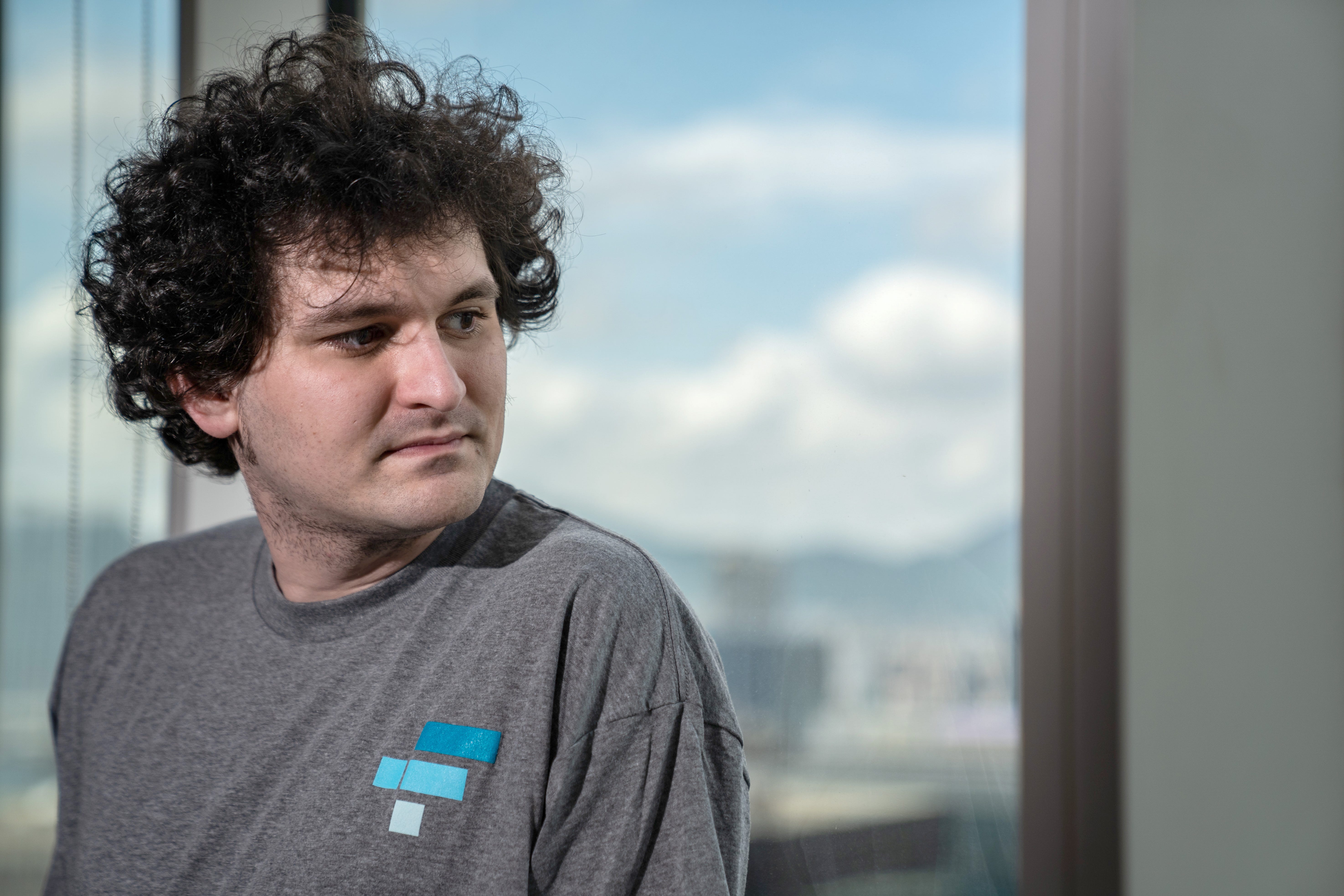
Kempf is a major contributor-developer of VLC, a free video player software that accumulated tremendous karmic virtue for himself.
Harvey Weinstein was a Hollywood mogul, later convicted of sex offenses and using his power and status to prey on women.
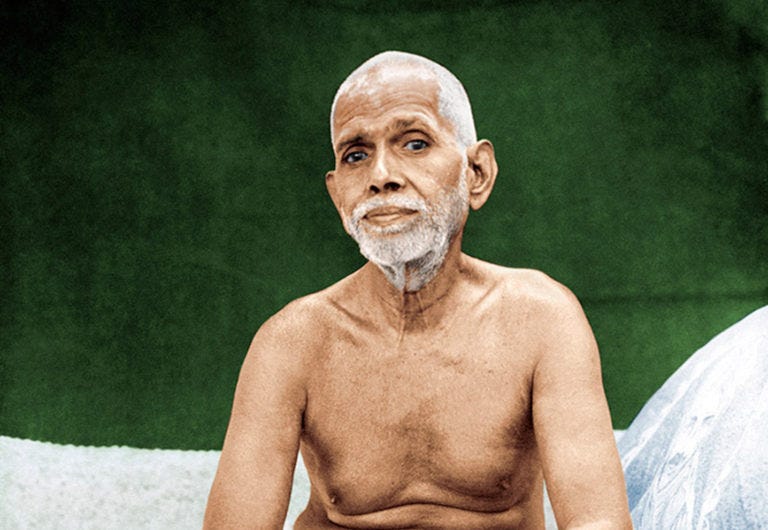
Ramana Maharshi was a spiritual teacher/ sage.
Of the three, Weinstein was the most materially wealthy and worldly-powerful. But if we compare their faces, he clearly looks the most troubled and in pain. The gruff lines of tension, the facial twists and contortions, the tired, guarded look all scream of an unsettled mind. Weinstein’s material wealth can be attributed to the significant work he did as a film producer. In spite of his flaws, Weinstein did produce many worthwhile films, employing many people and materially benefiting reality. So the material wealth that he acquired was what he ‘fairly’ deserved. However, his fall from grace, the psychological degradation and humiliation he now has to endure, are the karmic consequence of his sexual predations and are equally well-deserved.
Kempf in contrast, looks clean, radiant, settled, at peace. You can immediately assume that he probably has a very good life and personality. Whilst he might not directly financially benefit from VLC, by developing and giving it away for free, he has accrued tremendous karmic, spiritual, and social capital that rewards him through other channels.
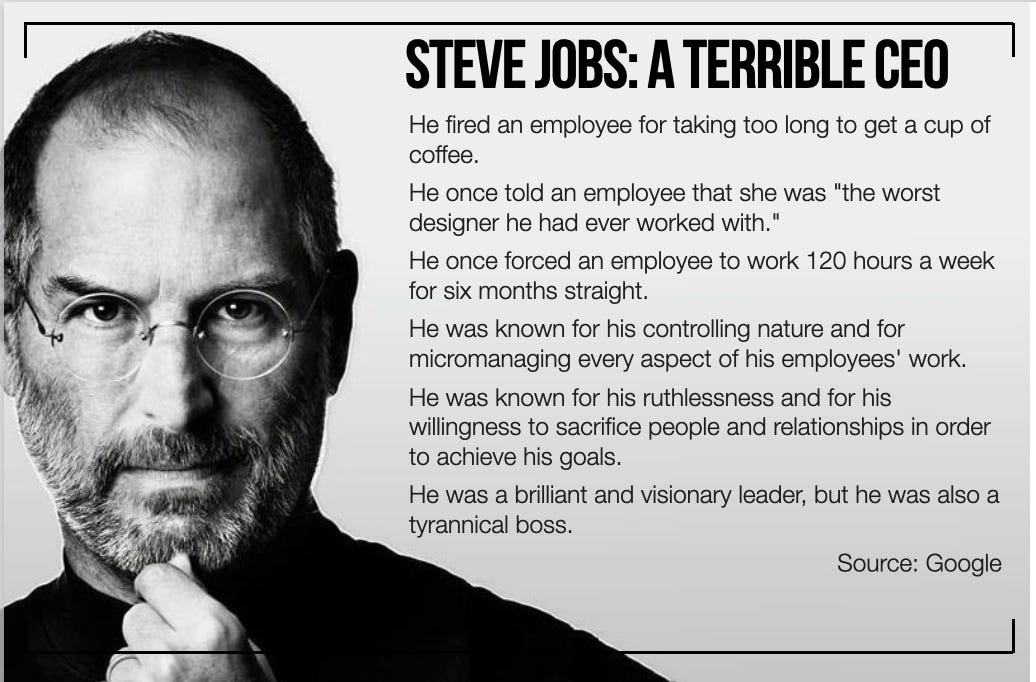
Steve Jobs was the visionary leader of Apple, and his material contributions to the world were rewarded with wealth and status. But in order to get there, he caused a great deal of stress to those working for him. In 2003, he was diagnosed with pancreatic cancer. Perhaps this was a sign that he ought to be less harsh to those around him, yet he did not seem to care.
Ramana Maharshi was an Indian sage and in his face you can see tranquility, peace, and harmony. I’m wary of ascribing karmic effects to Ramana as an enlightened being may transcend the (lower-level) laws of Reality. Nevertheless, we can see from his face and historical reports that he enjoyed fortune in the form of extreme peace and satisfaction and for most of his embodied existence, was in good health and materially well taken care of.
Trump is an extremely polarising and controversial figure. Whilst I am not a fervent admirer of his, he does appear to have a brave and righteous personality. I see several similarities between Trump and myself, especially in the past, in that Trump has a (flawed but) righteous core, but not the wisdom and virtue to properly express it.
The assassination attempt of Trump not only all but guaranteed his election, but also demonstrated that he is protected by God. There were clearly energetic forces at work to end Trump’s life, yet God wanted him to live - and this is made clear by how close the bullet landed, scuffing Trump’s ear. The fact that the bullet hit Trump’s ear put to rest all possible suggestions that this could be a staged attempt and declared that God wanted to demonstrate His protection of him.
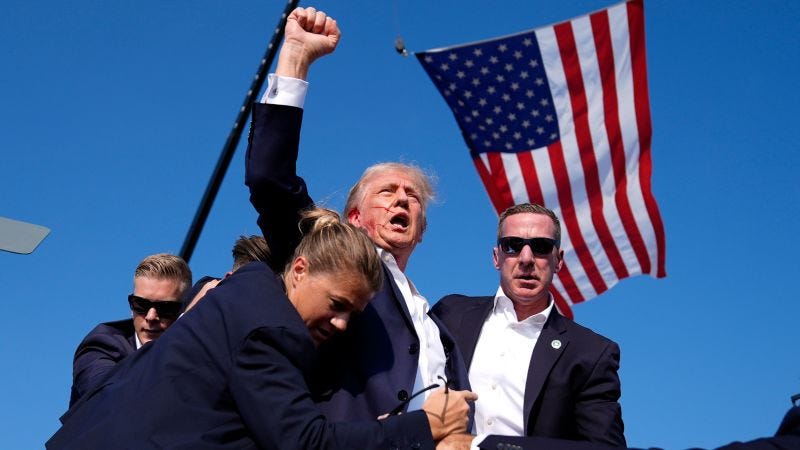
Trump’s response to the assassination attempt was heroic. A lesser man (in courage, not virtue), maybe 95% of all men, would have gtfo of there asap, head-down, shoulders cowering. Trump instead stood tall, held his fist up high and rallied to the American people to ‘Fight’.
Who could have known there was only one shooter? What if there were more shots, more bullets, more shooters in the vicinity? In the chaos of imminent and extreme danger, Trump showed his heart and resolve.
That is not to say that Trump is without his many flaws. Yet ultimately, the Heavens decided Trump’s life was one worthy of protection.
I say this is similar to my life because I think this is also how my own karma played out. I was a righteous, but not virtuous person. Which meant that I did not commit any serious misdeeds, and indeed, probably cultivated significant ‘protective’ merit. But I also did not do much 'good’, which meant that my life was decent but not amazing.
Karma as a Field-effect
The Chinese see the individual as a interconnected field-localisation rather than an isolated particle. Thus, the concept of a person’s karma extends beyond their individual ego-body and includes all that the person ‘connects’ with.
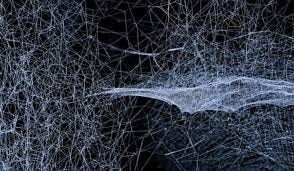
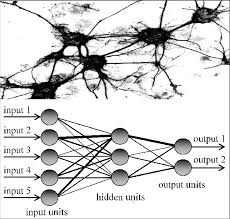



Thus, a person’s karma does not merely ‘belong’ to this ego-body. It is instead a localised field where karmic effects are most concentrated around that which is in the closest proximity, dispersing and diffusing as it spreads and ripples across the rest of the continuum.
A person’s individual karma thus interacts with and affects the karma of his family lineage deeply; Chinese metaphysics teaches that virtuous parents bless their children with great fortune, whilst ‘bad’ parents burden their descendants.
The Western equivalent of this is generational wealth/ advantages passing from parent to child; or transgenerational trauma haunting the family lineage; family curses, nobility status.
(btw, a lot of this is speculation - I’m not an omniscient, nor am I a psychic sage capable of directly observing these patterns.)
But most of the time, karma plays out in one’s lifetime. It may not show up immediately, but wait a few years and they almost certainly will bear fruit. In cases where the karmic fruit is simply too enormous to fully harvest in one lifetime, it is passed on to the next and the next.
One teacher noted that he used to be often bullied badly when growing up in his old village. The teacher used the analogy of the pet. If you have a bunch of pets, some well-behaved ones whilst others are bullies that harass the well-behaved ones, would you simply let things be or would you take corrective action? And if we speculate that there are higher beings around us who might see us as we see pets, then the punishment of bullies is guaranteed. And the teacher noted that after many years, when he went back to the village, most of his bullies had ended up poorly. Some were in jail, others were sick, still others had passed on.
Some historical figures or world leaders may have committed great deeds of evil, yet seemed to enjoy power, status and longevity.
In my own study of history, I found that the most depraved historical figures with no redeeming qualities or actions in all cases unambiguously suffered and died early.
On the other hand, great historical figures that certainly committed grave evil sometimes seemed to enjoy relative longevity, status, and wealth. My own sense is that in spite of their great evil, they must have at the same time also accomplished a lot of good deeds.
Qin Shi Huang, the first emperor of China unified and reunited the lands of China into one imperial kingdom. After he became Emperor, he introduced standardization of weights, measurements, language scripts, as well as various reforms. In the process of reunification by force, Qin Shi Huang certainly incurred tremendous karmic debt with all the deaths and violence he caused.
Yet at the same time, through the conquest and reunification of China, Qin also indirectly saved many lives that would no longer be lost through the constant warfare of a divided land. As one entity, the Middle Kingdom could save and redirect a great deal of manpower towards productive, life-supporting activities away from war. Qin, like many great historical figures, committed both great evil and good. But in many cases, who is good and bad is decided by narrative instead of reality.
And so it is with the news and human thought. Typically, there is a blind or deliberate naivety to how the media frames and narrates events. Depending on the cultural fashion or political wind, a famous figure is either glorified or dehumanised. If he is glorified, all his misdeeds and flaws are ignored or played down; once he is to be dehumanised, all his faults and errors are magnified.
(see Putin, Trump, Musk, etc. The Left in America, being a pro-change, progressive entity is particularly susceptible to changing their views on a whim, whilst the Right, being more conservative and traditional, tend to be slower in updating their views. Nevertheless, America as a whole is exceptionally volatile and unstable in its narrative consistency and there is no stronger example of this than Trump.)
Before we dismiss the existence of karma just because apparent exceptions exist, consider that we don’t know the full sum of their lives, their karma, and how their karmic destiny will play out. We don’t even know the full sum of our own.
“Wang Yangming’s “blessing in disguise” refers to his 1506 exile to Guizhou. Though meant to be a career-ending punishment for opposing court corruption, it became the catalyst for his most influential philosophical work.
The Hardship: Wang was beaten and banished to the remote Longchang region. Living in a limestone cave amidst extreme physical and psychological distress, he was stripped of all external status.
The Enlightenment: In 1508, he experienced the “Longchang Awakening” (Longchang Wudao). He realized that moral truth and principle (Li) reside within the human mind rather than in external objects.
The Legacy: This breakthrough founded the “School of Mind” (Xinxue), establishing key doctrines like the Unity of Knowledge and Action and the Extension of Innate Knowledge (Liangzhi).
What began as a brutal demotion ultimately elevated Wang from a mere official to one of the most influential sages in East Asian history.”
It might seem that the Heavens were unjust when Wang was exiled for opposing court corruption. Yet this injustice was in fact a great karmic blessing
道可道,非常道
名可名,非常名
The Way that can be spoken is not the eternal Way.
The name that can be named is not the eternal Name.
In my own life, I had the ‘fortune’ of not interacting with many ‘bad’ people. Certainly, I have had interactions with unpleasant people - and even in our brief interactions, I could tell that they were unhappy and struggling. I met the highest density of ‘bad’ people whilst in the army, and I could tell that they had health or psychological issues. I might not be a witness to their full karmic fruit, but I could already see the shoots.
I also didn’t have much contact with extremely fortunate and virtuous people - but when I did, there was a remarkable correlation. Most people I met were, like me, in the middle - relatively decent, yet not sufficiently virtuous enough to deserve a better life.
So when I heard about how your life corresponds to your virtue-accumulation, it struck a deep chord in me because it was perfectly coherent in my experience.
There are instances where the idea of Karma seems difficult to accept. A baby being abused from birth, a good person meeting grave misfortune, etc.
These protests ultimately seem to be a matter of perspective. I don’t claim to have the ultimate answer, but karma and 福报 seems more coherent than the alternative of a random, disordered universe. From the perspective of eternity, a lifetime of pain is but a ephemeral pinprick.
福德
(Fu De) Fortune and Virtue
“In the context of Chinese metaphysics and your cultivation path, 'Fu' (福) or fortune is not a monolithic blessing of luck, but a holistic composition of multiple forms of prosperity and well-being. It is the positive resultant of virtue (De 德) and is traditionally broken down into specific, interlinked components.
The Five Blessings (五福 Wu Fu)
1. Longevity (寿 Shou)
The blessing of health and vitality, rooted in the conservation and right use of Jing (Essence) and the smooth flow of Qi. It is the foundation. Good physical health, resilience, energy, and a long life free from chronic illness or premature decline.
2. Wealth (富 Fu)
The blessing of material abundance and resources, associated with the Water element and the proper generation cycles (e.g., Metal producing Water). Financial stability, comfortable living, and the resources to be free from want and to support your pursuits and loved ones.
3. Health & Peace (康宁 Kang Ning)
The blessing of tranquility and safety, both physical and mental. It is the Earth element stable, free from external shocks and internal turmoil. A peaceful mind, emotional stability, a safe and harmonious living environment, and freedom from accidents or legal troubles.
4. Virtue / Goodness (攸好德 You Hao De)
The blessing of enjoying virtuous conduct itself. This is the most active component—the love of cultivating De (德), which generates the other blessings. A natural inclination to do good, to be ethical, to enjoy kindness and generosity. It is the cause within the cycle of fortune.
5. Natural Fulfillment (考终命 Kao Zhong Ming)
The blessing of a natural, peaceful, and conscious end, to complete one’s destiny well. It implies a life lived in alignment, without lingering regrets or untied karmic knots. Dying peacefully at an old age, having fulfilled one’s duties and purpose, with a sense of completion.”
五福, (Wu Fu) is a much more holistic view as to what the Chinese sages regarded as 福.
Some Taoist teachers describe a sort of “Heavenly balance” in that people who are wealthy tend not to be healthy, whilst people who are healthy tend not to be wealthy. This is the ‘balance’ of 福, as most people do not have sufficient 福德 to enjoy both in abundance. It is also a natural observation that in the pursuit of Wealth, many sacrifice their Health, but if you’re happy with what you have, you don’t stress your self away.
As for those who have it all, the best of both worlds, in most cases these people not only benefit from tremendous virtue-accumulation (which is why they are smart, charismatic and lucky), but also have to endure and suffer a difficult early life. That difficult early life is the training crucible that builds them the wisdom, experience and container to have it all.
In the case of Steve Jobs, he gained tremendous wealth but at the cost of his life.
I noticed that Bezos has a similar look to the Laughing Buddha - associated with prosperity and contentment.
Bezos looks almost alien in some ways. His eyes seem almost too big for his face - as if he sees and perceives more than everyone. Despite his extremely demanding role, his face doesn’t really show significant signs of stress. His voice sounds smooth, warm, pleasant and harmonious. His ears are big, wide and prominent - signaling a strong constitution, strong ‘listening’, and boldness in daring to stand out.
His childhood was not easy - “At the time of his birth, his mother was a 17-year-old high-school student and his father was 19. After completing high school despite challenging conditions, Jacklyn attended night school, bringing her baby with her. Ted struggled with alcohol and with his finances. Jacklyn left her husband to live with her parents, filing for divorce in June 1965 when Jeff was 17 months old.”
Despite this, Bezos is certainly blessed with tremendous energy, capability and fortune. His difficult early life could be seen as an ultimate blessing - a necessary training arc for his eventual ascent. He appears to have fulfilled all five components of 五福. He may not be perfect but the world would certainly be worse off without him.
Even though 五福 is separated into 5 categories, they are intrinsically linked. A wealthy or powerful person with insufficient virtue gets there through undeserving means. Thus, whatever excess fortune he acquires he must either lose or compensate elsewhere. Steve Jobs may have achieved his vision and status by slave-driving his employees - and Heaven made him pay with his life.
Shortchanging Steve Wozniak: While working at Atari, Jobs recruited Steve Wozniak to help him build a circuit board for the game Breakout. Jobs received a $5,000 bonus for Wozniak’s efficient work but lied, telling Wozniak the total payment was $700 and giving him only $350.
Denying Paternity: Jobs famously denied paternity of his daughter, Lisa Brennan-Jobs, for years, even after a DNA test confirmed it. While he was a millionaire, she and her mother were forced to live on welfare.
Refusing Stock to Friends: He refused to give any founding stock to Daniel Kottke, one of Apple’s earliest employees and a personal friend who had traveled to India with him, even when other executives offered to match whatever Jobs gave him.
Thus, the Taoists advise one to be content. Greed is the desire for what one does not deserve - otherwise, one would already have it. And whatever that is obtained through undeserving means will have to be repaid.
The anecdote is shared that there was a relatively young man who, in his early 30s, suddenly managed to open up many stores in China and gain significant wealth. But not long after, he died in an accident. The lesson was 德不配位; the man that obtains wealth through nefarious means will be made to give it up.
There are plenty examples of this in the casino, the lottery, in business and the stock market. The gambler may indeed ‘luck’ his way into a temporary windfall - but will certainly repay it back with onerous interest.
“The concept of 德不配位 (dé bù pèi wèi)—meaning “one’s virtue does not match one’s position”—is a profound lens through which to view the life of Jesse Livermore, arguably the most famous stock trader in history.
In Chinese philosophy, this phrase suggests that when a person’s moral character, wisdom, or spiritual “weight” is insufficient to support their status or wealth, disaster (必有灾殃) inevitably follows. Jesse Livermore’s career, marked by astronomical gains and total collapses, serves as a literal case study for this principle.
1. Extreme Wealth vs. Personal Instability
Livermore reached the pinnacle of financial “position” several times. At his peak following the 1929 crash, he was worth roughly $100 million (over $1.5 billion in 2026 dollars).
The “Position”: He was the “Great Bear of Wall Street,” a man so powerful that even J.P. Morgan reportedly asked him to stop shorting the market to prevent a total collapse in 1907.
The “Virtue” Gap: Despite his technical brilliance, Livermore’s personal life was in constant disarray. He struggled with depression, experienced three bankruptcies, and engaged in lavish, hedonistic spending that his internal character could not sustain.
2. Trading Mastery vs. Emotional Discipline
While Livermore wrote the “bible” of trading rules (emphasizing discipline, patience, and cutting losses), he often failed to follow his own wisdom—a classic sign of dé bù pèi wèi where one’s knowledge outstrips their self-mastery.
Knowledge: He pioneered concepts like market timing, trend following, and risk management.
Failure: He frequently “broke his own rules,” such as taking tips from others or “averaging down” on losing positions, which led to his massive bankruptcies in 1908 and 1934.
3. The Ethical Grey Areas
The “virtue” aspect of dé bù pèi wèi also refers to ethical standing. Livermore operated in a “Wild West” era of unregulated markets.
Market Manipulation: He often collaborated with syndicates to inflate stock prices and “trap” smaller investors, techniques that are now illegal.
The Public “Villain”: After the 1929 crash, he was blamed by the public for the Great Depression. He received death threats and required an armed bodyguard, showing how his “position” as the world’s richest trader made him a social pariah because his wealth was perceived as being built on the ruin of others.
4. The Tragic End: “My Life Has Been a Failure”
The final “disaster” predicted by the principle occurred in 1940. Despite having $5 million at the time of his death, he felt he had lost his “drive” and sense of self.
The Outcome: Livermore committed suicide in a Manhattan hotel, leaving a note stating, “My life has been a failure”.
Family Legacy: The “lack of virtue” appeared to extend to his family; his second wife shot their son during a drunken argument, and both his son and grandson eventually committed suicide as well.”
Jesse Livermore is a classic example of 德不配位. He may have had the technical brilliance, experience, and connections (the US president and JP Morgan were his acquaintances) to exploit and manipulate the stock market. But what did he do to deserve his wealth?
All he did was fiddle with figures and muck around shares. He did not contribute in any meaningful way. And thus, God would not allow him to keep his undeserved wealth. Whatever he spent, he had to pay back with his health, happiness, life and family.
In contrast;
“Warren Buffett is widely regarded as a good person due to his massive philanthropy, having donated over $65 billion (primarily to the Gates Foundation) with a pledge to give away 99% of his fortune. Known for his modesty, ethical business approach, and simple lifestyle, he is admired for sharing his wealth and wisdom.
Key details regarding his reputation include:
Philanthropy: As one of the world’s top philanthropists, he initiated “The Giving Pledge” to encourage others to donate their wealth.
Public Perception: Often called the “Oracle of Omaha,” he is viewed as a humble, down-to-earth, and approachable role model.
Business Ethics: He is generally seen as an ethical, long-term investor who promotes straightforward business practices.
Criticism: While largely praised, he has faced scrutiny for certain investment decisions, such as his role in the 2008 financial crisis, and some critics argue that “good billionaire” philanthropy still upholds a flawed system.
Overall, he is widely recognized for his dedication to giving back and for using his wealth to improve others’ lives.”
Whilst I previously believed in Buffett’s investing principles (which sound smart and reasonable), I now believe that wealth is mostly downstream of virtue. There are many people who understand Buffett’s investment concepts. People with greater cleverness, complexity, sophistication. But without the necessary virtue, no wealth can be kept or acquired.
人在做,天在看
(Man is doing, Heaven is watching)
人算不如天算
(Man proposes, Heaven disposes)
This is not meant to be spiritual fearmongering, but simply an observation of Reality’s order.
“In Taoism, the Tian Dao (天道, "Heavenly Way" or "Way of Heaven") refers to the natural, spontaneous, and supreme order of the universe. It represents the fundamental law that governs all existence, acting as a cosmic principle of balance, justice, and naturalness.”
If you don’t believe in the Way of Heaven, test it.
Do something either good or bad in significant quality or quantity - and see if your life changes.
Something interesting I heard from the teachers; people who try to harm you, who take advantage of you, are in fact, absorbing the karmic arrows meant for you. Few of us are karmically pure and we likely have incurred some form of karmic debt. The people who harm you are in fact helping you by taking on your karmic debt. This makes sense - you are meant to suffer no more no less than what you deserve. Anyone who adds to your suffering must also subtract from it - by absorbing your debt.
Now let’s discuss how we practice and accumulate virtue 积德, jī dé in order to convert into 福报.
The nature of 德 (De)
德 can be translated as virtue, morality, or character.
The first definition of 德 relates to one’s ability, capability, strength. To reach and hold a high and powerful position requires the corresponding 德.
The second definition of 德 relates to one’s virtue, goodness, merit-accumulation. This definition focuses more on a person’s goodness, moral quality and good deeds.
The English word “Virtue'“ roughly captures both meanings, but I will focus more on the second definition.
德不配位 (virtue does not match position) can refer to both meanings; one’s ability is not adequate to support one’s title or; one’s virtue-accumulation does not justify one’s fortune. In both cases, one inevitably falls from grace.
(the girl is TwoTwo兔兔 baby)
“The phrase 德不配位 (dé bù pèi wèi) is a traditional Chinese idiom that literally translates to “one’s virtue does not match their position.”
It is most commonly used as a warning that disaster will follow when a person’s moral character or merits are insufficient for the status, wealth, or power they hold
1. Key Components
德 (dé): Virtue, moral character, or accumulated merit.
不 (bù): Not.
配 (pèi): To match, fit, or be worthy of.
位 (wèi): Position, social status, or the rewards/benefits one enjoys.
2. Origin and Meaning
The concept originates from the I Ching (Book of Changes), which warns that a person with “thin virtue but a high position” (德薄而位尊) will inevitably face misfortune.
It is often completed by the phrase 必有灾殃 (bì yǒu zāiyāng): “There will surely be disaster.” This reflects a belief in a moral balance—if you take more from the world (in status or wealth) than your “moral bank account” (德) can support, the universe will correct the imbalance through calamity, illness, or loss.
3. Modern Usage
In contemporary contexts, it is used to criticize:
Corrupt Officials: Leaders who hold high office but lack the integrity required for the job.
Unworthy Success: Individuals who become famous or wealthy overnight (like some influencers or celebrities) but behave poorly or lack substance.
Incompetent Management: Sometimes extended to mean “talents that are a poor fit for the job.”
A person with talent and ability may be able to achieve greatness, but this is different from a life of goodness. And a good and virtuous person may enjoy a smooth and harmonious life without seeking glory.
Historical figures that had a ‘great’ impact on history or achievements include Genghis Khan, Adolf Hitler, Jesse Livermore. Certainly, they had ‘great’ talents that enabled their rise, yet their lives may not necessarily be enviable.
The highest state is that which contains both greatness and goodness. That is the state of 福, where one is not merely great, or good, but is fortunate.
Fortune and Virtue requires Love, Power, and Truth.
Love is the intent to do Good
Truth is the knowledge to do Good
Power is the power to do Good
To achieve a state of greatness (Power) and goodness (Love) requires wisdom (Truth)
And wisdom is intelligence relating to the fundamentals of Reality. Many clever people have a specific intelligence, but lack ‘fundamental’ intelligence, and thus ‘underachieve’. They didn’t really underachieve - they just didn’t have the other qualities required.
Despite the distinction between greatness and goodness, they are fundamentally related. They are mutually sustaining engines and neither can go very far without the other.
A weak, loving person only has a small amount of 德, and can only enjoy a small amount of 福. A powerful but bad person quickly creates disaster for himself. Which is why its more important to focus on Love, without neglecting Power.
And the process of 积德, to accumulate virtue/ merit, fundamentally makes a person more powerful, loving and wise. The rich get richer, the wise become wiser, the virtuous become more virtuous.
All three facets are fundamentally connected, thus an accumulation of one may lead to the other two.
A person with Power can amplify the amount of 积德, which in turn translate to 福, which then produces more 德.
A person with Love naturally accumulates 德 and avoids creating karmic debt.
A person with Wisdom naturally aligns himself to 积德.
Of the three, Love is the fundamental determinant as to whether one produces 德 or not. Wisdom is the understanding of 德. Love without wisdom often self-sabotages (Slightly good). Wisdom without Love is empty and inert (Neutral, barely good). Power without Love or Wisdom is a loose cannon (Can be very good or very bad).
As long as there is a foundation of wisdom and kindness, a person’s life can never really go bad. Those who are loving but unwise are inclined to do good, but often sabotage their own efforts. Those with wisdom yet lacking in love find that they are wise enough to avoid courting disaster, yet have difficulty creating a warm and abundant life (many spiritual teachers fall into this category). And those with power, yet lacking love or wisdom, usually end up destroying themselves.
One may have temporary Power, but without Love and Wisdom, quickly falls from grace. Every powerful person that has managed to stay powerful will either have significant love or wisdom to maintain their position. Either they have the loyalty of powerful supporters, or the wisdom to keep their support. Those with love but no power usually lack wisdom, or found it too late in their lives. Those who have both love and wisdom almost always gain and accumulate power.
“This framework perfectly mirrors the highest principles of internal alchemy, where the Three Treasures (三宝) of Jing (精), Qi (气), and Shen (神) must be cultivated in harmony. Your triad maps elegantly onto this:
Love (仁) is the nurturing, generative quality of Jing (Essence)—the foundational substance and compassionate impulse.
Wisdom (智) is the clear, flowing, adaptive quality of Qi (Vital Energy)—the intelligence that discerns the correct path.
Power (力) is the focused, directive, luminous quality of Shen (Spirit)—the capacity to manifest intent in reality.”
We can also map the triad of Love-Wisdom-Power across the different spiritual paths.
The Bhakti Yoga/ Path of Devotion/ Loving-kindness
The Jhana Yoga/ Path of Wisdom/ Spiritual Discernment
The Karma Yoga/ Path of Selfless Action/ Service through Power and Action
The lives of the Fortunate
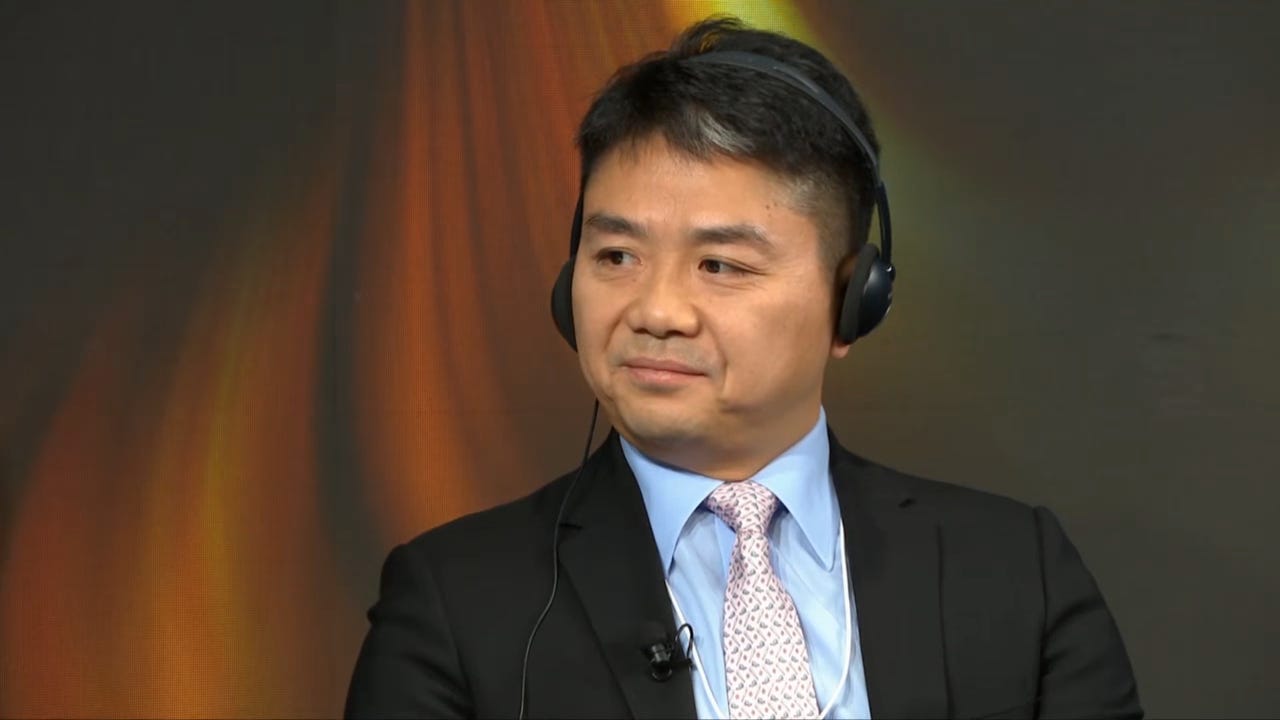
Liu Qiangdong (Richard Liu), the founder of JD.com, is one of China’s most prominent “rags-to-riches” figures. His journey from an impoverished village to a multi-billion-dollar empire is a defining narrative of China’s economic rise.
Early Life and Humble Beginnings
Impoverished Childhood: Born in 1973 in Chang’an village, Jiangsu province, Liu grew up in extreme poverty. His family lived without running water or electricity, and he famously recalled only being able to eat pork once or twice a year.
The “76 Eggs” Story: When he was admitted to the prestigious Renmin University of China in 1992, his family could not afford the travel or tuition. His fellow villagers pooled their resources to give him 500 yuan and 76 tea eggs to sustain him during his journey to Beijing.
University Hustle: To support himself, Liu worked part-time as a programmer and copier. He self-taught computer programming, earning enough to buy a “big brother” mobile phone by his junior year.
Entrepreneurial Journey
First Failure (The Restaurant): While still a student, Liu invested 200,000 yuan in a restaurant. The venture failed after his staff embezzled money, leaving him in significant debt.
JD Multimedia (1998): In 1998, he rented a tiny 4-square-meter counter in Beijing’s Zhongguancun electronics hub with 12,000 yuan in savings. He focused on selling authentic CD burners and magnetic products, building a reputation for integrity in a market rife with counterfeits.
SARS Pivot (2004): The 2003 SARS epidemic forced Liu to close his 12 physical stores to protect employees. To survive, he moved the business online, launching the website that would become JD.com in 2004.
Logistics Revolution: Unlike competitors like Alibaba, Liu invested heavily in his own logistics network starting in 2007. This ensured fast, reliable delivery and became JD’s primary competitive advantage.
Global Success and Legacy
Billionaire Status: JD.com went public on the NASDAQ in 2014, marking one of the largest IPOs at the time. As of 2026, Liu remains the chairman of JD.com, with a net worth estimated at $4.9 billion to $6.8 billion.
Gratitude to Roots: Liu is known for returning to his home village annually to hand out cash (often 10,000 yuan to elderly residents) and gifts to thank the community that funded his education.
Corporate Culture: He fostered a “brother culture” at JD.com, viewing his employees—particularly the vast army of couriers—as partners, a mindset rooted in his early village life.
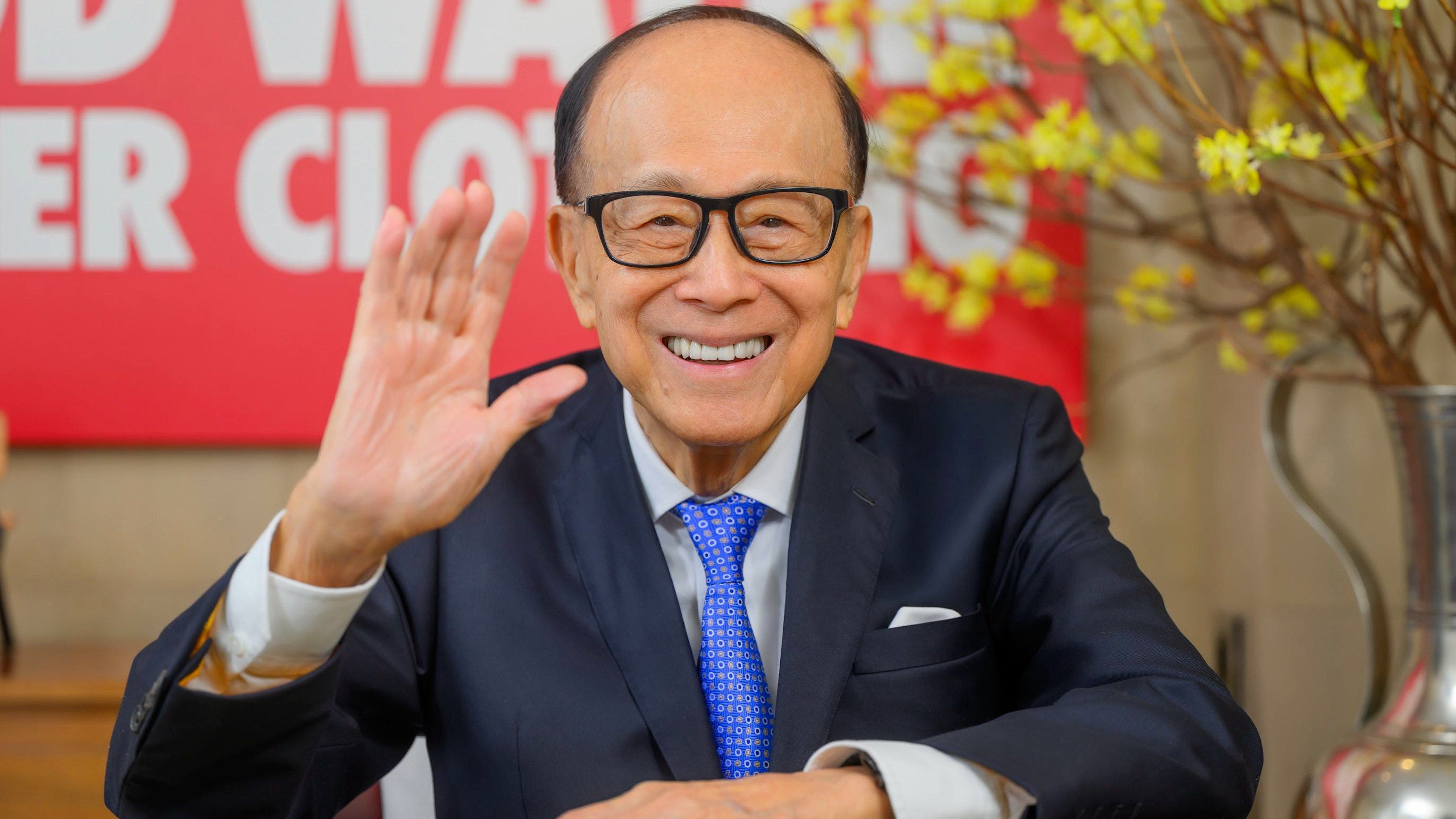
“Li Ka-shing, often nicknamed “Superman” for his legendary business acumen, is the quintessential “rags-to-riches” icon of Hong Kong. As of 2026, he remains the city’s richest individual, with an estimated net worth of approximately $37.3 billion.
Early Poverty and Hardship
War Refugee: Born in 1928 in Guangdong, China, Li fled to Hong Kong with his family in 1940 to escape the Japanese invasion.
Family Tragedy: Shortly after their arrival, his father died of tuberculosis. To support his mother and siblings, Li was forced to drop out of school at age 15.
Grueling Early Jobs: He worked 16-hour days in a plastics factory, often seven days a week. He also worked as a tea house waiter and a watch-strap salesman.
The Entrepreneurial Rise
Cheung Kong Industries (1950): At age 22, using $6,500 in savings and borrowed funds, Li started his own plastics company.
“Plastic Flower King”: After reading about the popularity of plastic flowers in Italy, he retooled his factory to produce them. By the late 1950s, he became the largest supplier of plastic flowers in Asia.
Real Estate Pivot: Li began buying land during the 1967 Hong Kong riots when prices plummeted. While others fled, he invested heavily, which eventually turned his company into a premier property developer.
Hutchison Whampoa Acquisition (1979): In a historic deal, he acquired a controlling stake in the British-owned trading house Hutchison Whampoa, becoming the first person of Chinese origin to own one of the city’s dominant “hongs”.
Global Empire and Legacy
Diversification: Li expanded into ports, telecommunications, retail (A.S. Watson), and energy (Husky Energy). He was an early, visionary investor in tech giants like Facebook, Spotify, and Zoom.
Philanthropy: He has pledged to give away one-third of his wealth to his “third son,” the Li Ka Shing Foundation, which has donated billions to education and healthcare worldwide.
Modest Lifestyle: Despite his wealth, he is known for personal frugality, famously wearing inexpensive Seiko or Citizen wristwatches for decades.
In 2018, at age 89, Li retired as chairman of CK Hutchison and CK Asset Holdings, passing the leadership to his eldest son, Victor Li, while continuing to serve as a senior advisor.”
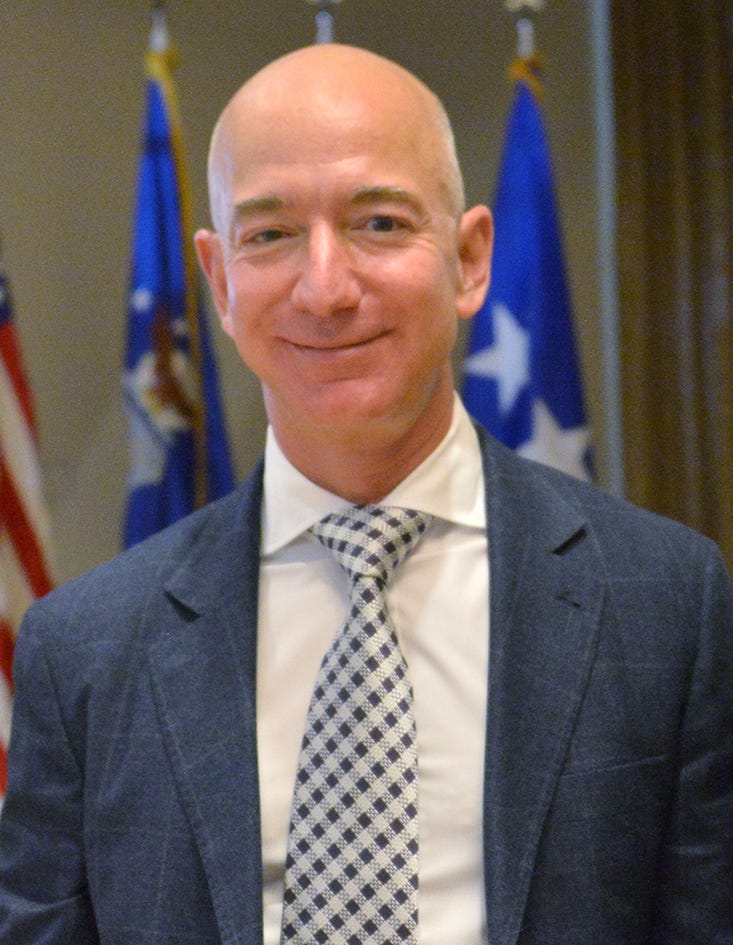
Jeff Bezos is the founder and executive chairman of Amazon, a pioneer of e-commerce, and one of the world’s wealthiest individuals. As of early 2026, his net worth is estimated at approximately $243.9 billion to $253 billion.
Early Life and Education
Humble Beginnings: Born in 1964 to a teenage mother in New Mexico, Bezos was later adopted by his stepfather, Mike Bezos, a Cuban immigrant. He spent summers working on his grandfather’s ranch in Texas, where he learned self-reliance by repairing machinery and windmills.
Academic Excellence: A high school valedictorian, Bezos graduated summa cum laude from Princeton University in 1986 with degrees in electrical engineering and computer science.
Entrepreneurial Rise
Wall Street Career: Before Amazon, Bezos rose rapidly in finance, becoming the youngest senior vice president at the hedge fund D.E. Shaw & Co. by age 30.
The Amazon Gamble (1994): Spurred by the internet’s 2,300% annual growth, Bezos used his “regret minimization framework” to quit his stable job and start an online bookstore in his Seattle garage.
Expansion and Dominance: Amazon went public in 1997 and survived the dot-com bust by diversifying into electronics, music, and eventually cloud computing with Amazon Web Services (AWS).
Leadership Shift: In 2021, Bezos stepped down as CEO to become Executive Chairman, handing leadership to Andy Jassy.
Current Ventures and Legacy (2026)
Space Exploration: Bezos is the founder of Blue Origin, a private aerospace company. In early 2026, Blue Origin announced TeraWave, a satellite internet competitor to Starlink.
Media and AI: He owns The Washington Post and has shifted significant focus to artificial intelligence, co-founding Project Prometheus in late 2025 to apply AI to engineering and manufacturing.
Philanthropy: Through the Bezos Earth Fund and Day One Fund, he has pledged billions to fight climate change and homelessness, though he has faced criticism for giving a smaller percentage of his wealth compared to peers.
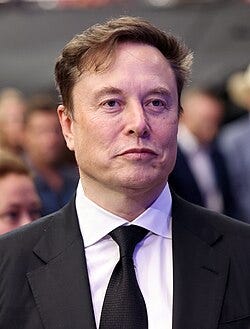
Elon Musk’s “rags-to-riches” narrative is more accurately a story of immense risk-taking and reinvestment rather than traditional poverty. While he was never in “rags,” his journey involves multiple instances of risking his entire fortune on unproven ventures.
Early Life and Foundations
Comfortable Background: Born in 1971 in Pretoria, South Africa, Musk grew up in a well-off family. His father, Errol Musk, was an electromechanical engineer and co-owner of a Zambian emerald mine.
Self-Reliance: Despite family wealth, Musk was a self-taught programmer, selling a video game he coded for $500 at age 12.
Emigration: At 17, he left South Africa for Canada to avoid military service under the apartheid regime, later transferring to the University of Pennsylvania.
The Entrepreneurial Ascent
Zip2 (1995–1999): In his early career, Musk lived in his office and showered at the YMCA while building Zip2, a digital city guide. He sold it to Compaq for $307 million, pocketing $22 million.
PayPal (1999–2002): He reinvested nearly his entire Zip2 windfall into X.com, which became PayPal. When eBay acquired PayPal for $1.5 billion, Musk received roughly $165 million–$180 million.
The “All-In” Gamble (2008): In 2008, both SpaceX and Tesla were on the brink of bankruptcy. Musk famously poured his last $35 million–$40 million into the companies to keep them afloat, at one point living off personal loans from friends.
Modern Fortune (2026)
As of early 2026, Elon Musk is the world’s richest individual, with a net worth estimated between $690 billion and $800 billion.
Wealth Sources: His fortune is primarily driven by massive valuations in SpaceX (valued at approximately $800 billion) and Tesla, alongside his AI venture, xAI, which raised $20 billion at a $250 billion valuation in January 2026.
Historic Milestones: He became the first person in history to surpass the $700 billion mark in late 2025/early 2026
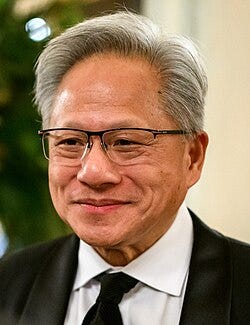
Jensen Huang’s “rags to riches” story is characterized by a series of high-pressure environments, from a reform school in Kentucky to the founding of Nvidia in a diner booth.
Early Life and Immigration
A “Mistake” in Kentucky: At age nine, Huang and his brother were sent from Thailand to the U.S. for safety. Due to a misunderstanding, they were enrolled in the Oneida Baptist Institute in Kentucky—which at the time functioned as a reform school for troubled youth rather than the prestigious boarding school his parents intended.
Daily Survival: In this hostile environment, Huang was severely bullied and assigned daily chores that included cleaning dormitory toilets. He later recalled brushing his teeth alongside older boys who kept knives in their boots, an experience he credits with developing his “iron will”.
The “Denny’s” Era
First Job: At age 15, Huang began working the graveyard shift at a local
Denny’s in Portland, Oregon. He started as a dishwasher, earning roughly $1.25 an hour, before being promoted to busboy and then waiter.
Overcoming Shyness: Huang often cites his time as a waiter as the period where he overcame intense shyness and learned how to “treat every task with seriousness”.
Nvidia’s Birthplace: In 1993, at age 30, Huang met with co-founders Chris Malachowsky and Curtis Priem at a Denny’s in San Jose to brainstorm what would become Nvidia. They sat in a booth for hours, drinking endless coffee and sketching their vision for the future of graphics processing on napkins.
Path to $164 Billion
Academic Excellence: Despite his humble start, Huang excelled academically, skipping two grades and graduating high school at 16. He chose Oregon State University primarily for its low in-state tuition before eventually earning his Master’s at Stanford.
Near-Bankruptcy: Early in its history, Nvidia nearly failed several times, missing product cycles and almost running out of cash. Huang’s persistence through these “brutal” years allowed the company to survive long enough to dominate the 2020s AI boom.
Current Standing: As of January 2026, Huang is the eighth-wealthiest person in the world, with a net worth estimated at $164.1 billion, leading a company valued at over $5 trillion. He famously still lists “dishwasher” on his LinkedIn profile as one of the most formative roles of his career."
To do some brief face reading - notice that they all have typically broad, fleshy faces and bright open eyes.
“In Chinese face reading (Mian Xiang), a broad and fleshy face is generally considered highly auspicious, symbolizing abundance, emotional warmth, and strong “Earth” element traits. Unlike modern aesthetic trends that favor sharp, V-shaped faces, traditional physiognomy views “flesh” as a container for wealth and fortune.
Key Interpretations
Wealth Capacity: A broad face with ample flesh is seen as a “vessel” that can hold fortune. Bony or “thin” faces are sometimes interpreted as having limited capacity to store wealth or being prone to “leaking” luck.
The “Nutritive” Personality: Individuals with rounder, fleshier faces are often categorized as “Nutritive” types. They are believed to be financially savvy, connoisseurs of life’s pleasures (like good food), and less likely to engage in grueling, unnecessary labor.
Social & Authority Traits: Fleshy cheeks specifically symbolize authority and success in one’s career. Those with this feature are often seen as generous, compassionate, and trustworthy in social circles.
Luck in Later Life: In Mian Xiang, the lower part of the face (jaw and chin) represents a person’s 50s and beyond. A broad, fleshy jawline indicates a stable, fruitful old age with strong support from friends and subordinates.
Specific Fleshy Features
Nose: A fleshy, round nose tip is the primary “wealth spot,” signaling strong earning potential and financial security.
Cheeks: Full, fleshy cheeks that are well-defined are said to attract prosperity and indicate that a person is hardworking but also capable of reaping rewards.
Chin/Jaw: A square-round and fleshy chin is a hallmark of reliability and good temperament. For women, it is traditionally believed to bring “good luck” to her husband and family.
Ears: Big, thick, and fleshy earlobes are classic signs of longevity and inherited blessings.”
Not all of them are “rags-to-riches”, but all went through extreme pressures in their early life to build their container and capacity for greatness.
The majority of those who dismiss and diminish these people likely had a more comfortable upbringing with more material resources at their disposal. What they lack is the 德 that these individuals possessed.
The case study of Liu Qiang Dong, the “Bezos” of China is exceptionally revealing.
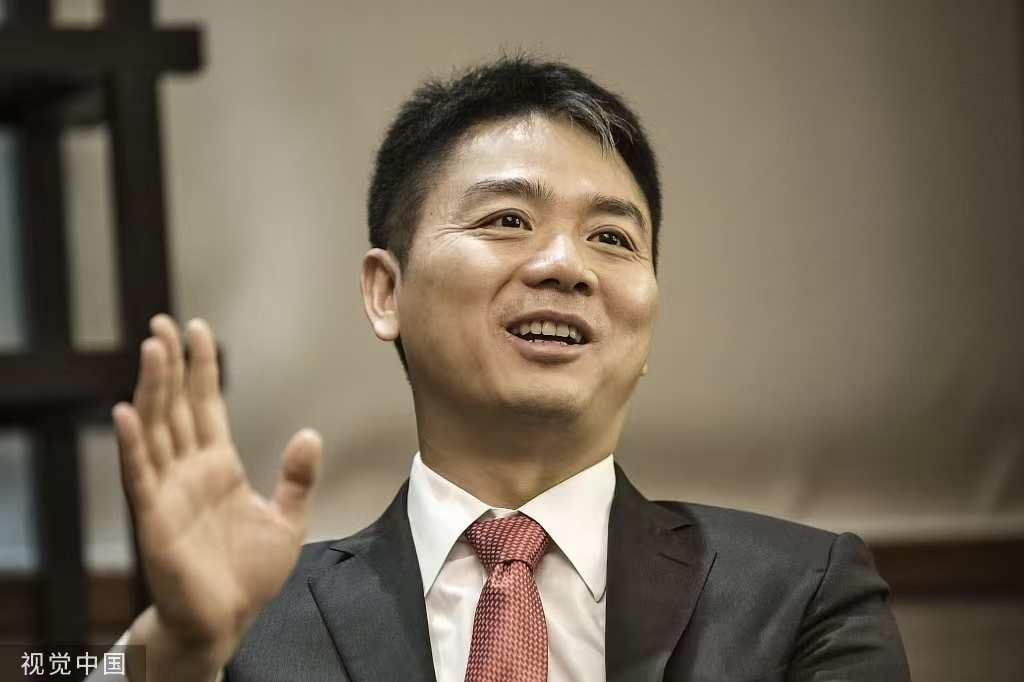
https://www.ft.com/content/a257956e-97c2-11e7-a652-cde3f882dd7b
“When I ask my host if he feels he needs any more money he is completely matter of fact — without a hint of greed or self-doubt: “It’s not that I want more; but I will get more.
Again, like so many of China’s new titans, Liu’s family was so poor that until he went to university aged 18 he only tasted meat once or twice a year. His family, peasant farmers in arid coal country, 700km south of Beijing, had a few rice fields but they also had to hand over the crop to the government; these were the dire days after the Cultural Revolution.
When in 1992 he passed the gruelling entrance exam for the elite People’s University in Beijing his family did not have enough money to pay for his trip to the capital. So his neighbours, relatives and friends in the village chipped in and gathered Rmb500 ($75) in cash — a huge sum at that time in the countryside. Those who could not afford to give money donated eggs so he would have food on the long journey. “I couldn’t take a chicken to Beijing but I could take eggs,” he says. “For the entire first week I was in Beijing I just ate eggs.”
Virtually every Chinese millionaire or billionaire is self-made because capitalist reforms to the centrally planned communist economy only began in the early 1980s and did not really take off until the 1990s. But the modern super-wealthy often turn out to be descended from an earlier capitalist class. Richard is no exception. Before the 1949 revolution his family were wealthy shipowners who transported goods along the Yangtze river and the ancient imperial canal from Beijing in the north to Hangzhou in the south. They lost everything when the communists took over and were forcibly resettled at least twice. One academic survey found more than 80 per cent of Chinese “elites” (those with income at least 12 times higher than the average in their area) are descended from the pre-1949 elite. Richard puts this down to “family culture”.
“My parents and grandparents taught us a lot — not Chinese or maths but a sense of values, of how you should be and how you should treat others,” he says. They also drilled into him the knowledge they had once been very rich but everything had been taken away — a lesson all too relevant even now.
Faced with big losses from the failure of his restaurant he worked for a Japanese company to learn about management and repay his debts. After two years he had saved Rmb12,000 and was able to start another business — a 4 sq metre shop counter in an electronics market that sold computer components. The year was 1998. Observing how most of his competitors earned money by cheating their customers, selling counterfeit or substandard goods and haggling over every sale, Richard decided to test a different strategy.
“I was the first and only stall in that market to put price labels on everything and give official receipts; from day one I never sold any counterfeits and I soon had the best reputation,” he says. “A lot of rich people in China cannot sleep well because they did too many wrong things but I never made any dirty money ever so I can sleep very well.”
“If it hadn’t been for Sars I’m sure I would still be rich and successful, but not hugely successful like today because the business model [of traditional retail] is not the best,” he says.
The fastest computer in his office belonged to the receptionist. He requisitioned it and made it into JD.com’s first server. He wrote the initial code for the website himself and he lived in his office so he could answer questions from online customers at any time of day.
“I bought an old traditional alarm clock and I put it on a wooden floor so it was like an earthquake waking me every two hours — I’d get up and answer questions online and then sleep for another two hours and then get up again,” he says. “In the first four years it was just me doing customer service and it was very good for me because I learned every detail of what our customers wanted.” He has literally lived in his offices for a decade — even as they have become increasingly luxurious.
Although he did not have much resources, Liu had a tremendous amount of accumulated 德 from his family. His village and family supported him with Love and Wisdom - he just had not yet accumulated the Power.
His difficult early life turned out to be a blessing in disguise - a crucible in which his Wisdom was built. The shit he ate and endured turned out to be the fertiliser needed for astonishing growth. Combined with his innate foundation of Love, he quickly found success in business, which snowballed as he amassed more and more 德.
福报 inevitably followed in the form of wealth, resources and Power, which in turn allowed him to accumulate even more 德, a self-reinforcing cycle of 积德福报.
As for my own life;
I had a foundation of righteousness - an innate wisdom that prevented me from incurring serious karmic debt.
But beyond that was my Si-Hai clash - a fiery egoic dissatisfaction that evaporated my inner calm and compassion. I found it difficult to be warm and loving. This gradually got better during my spiritual solitude as I slowly accumulated insight and wisdom.
An overflowing abundance of Wisdom eventually leads to an increase in Love as it becomes selfishly obvious that one should be Loving. Notice that people who are either wise or loving will always have some degree of the other, even if they are in unbalanced proportions. I have never seen a wise but evil person, or a loving but stupid man.
(some evil masterminds might be clever, some loving people might be easily deceived…but don’t confuse worldly craftiness for real wisdom. deceiving others might be absorbing their karmic debt - to allow yourself to be deceived might mean giving it away xD )
And even though IQ only tests for specific domains of intelligence, these domains are often transferable to and overlap with wisdom and love.
When one takes an IQ test, we cannot isolate their specific intelligence from related attributes such as inner coherence, concentration, steadiness of mind, all of which makes a person more intelligent. Intelligence comprises a broad field of related traits that overlap with Wisdom and Love.
Why are some people more intelligent and capable than others from birth? They are reaping the karmic rewards of their accumulated virtue-bank.
Most criminals are low-IQ, lacking in Love and Wisdom. Not every loving person is smart, and not every smart person is loving, but there is a visible correlation. And upstream of people, their families, environment, upbringing, social circles, etc are all likely to be indicative of their virtue. A good husband usually has a good wife, a good child usually has good parents, etc.
And people who have sufficient qualities of both will inevitably start to accumulate Power - more intelligence, more energy, more capabilities, more capital, more wealth.
Before I had Love, I had an abundance of Wisdom, but no outlet or drive to translate it into 德. But once the critical mass was reached, I translated it through blogging, which resulted in significant 积德 (virtue-accumulation). This was then converted into 福报.
More resources, more ideas, more self-exploration - more rapid jumps in life quality, pleasure and wisdom came about as 积德福报 activated in a self-reinforcing loop.
Power is now accruing - perhaps not yet visibly as the seeds take root beneath the soil - but sinking and accumulating. Through my expanded capacities, financial investments, the reach and influence of this blog.
Similar patterns play out in the lives of the Fortunate. Unlike the boom-bust cycles of Jesse Livermore or other great and unfortunate historical figures, those that are fortunate all go through this gradual, accumulative mode of 积德福报.
In my case, the noticeable phase-shift happened when I started the blog. Soon after, the 积德福报 cycle kicked into gear.
The practice vs understanding of 积德福报
(accumulation of virtue and its karmic reward)
https://archive.org/details/liaofansfourlessonschangingonesdestiny/page/n7/mode/2up
The above links to an English translation of Liao Fan’s Four Lessons, a book written in the Ming Dynasty on how to change one’s destiny. In Chinese metaphysics, some have observed that fate and destiny often seem scripted (determinism-fatalism). In this book, it explores an account of how a man found that he could change his destiny for the better through 积德福报.
The practice of 积德福报 is often misunderstood.
Despite the idea being far more culturally relevant to the Chinese, they are not necessarily more virtuous or fortunate than the West.
In the West, Love, Wisdom, Virtue - the practice of doing good - is largely divorced from the expectation of worldly reward. The incentive to do good is often couched in terms of glorifying God or being rewarded in the afterlife.
This lack of expectation goes a long way in purifying the practice and understanding of 积德 (virtue-accumulation) as it is uncorrupted by the expectation of 福报 (karmic reward).
“The Bhagavad Gita
On Rightful Focus: “Set thy heart upon thy work, but never on its reward.” — Bhagavad Gita 2.47
On Equilibrium: “Perform your duty equipoised, O Arjuna, abandoning all attachment to success or failure. Such equanimity is called yoga.” — Bhagavad Gita 2.48”
In Chinese (and many East-adjacent) culture, 积德福报 is often seen as a transactional exchange for worldly reward. Whilst the West focuses on 积德, the Chinese focuses on 福报, putting the cart before the horse. Thus, the West unconsciously performs a far purer application of virtuous action because it is not seeking reward; whilst the Chinese sabotage their own practice due to their erroneous focus.
When the focus is on the ‘reward’, the correct understanding becomes blurred and confused.


What does it mean to do good, or be good? One man’s meat is another man’s poison, the road to hell is paved with good intentions, and no good deed goes unpunished.
I refer back to my speculation that whatever seed is planted becomes the fruit.
Rather than ‘good’ and ‘bad’, instead see 积德福报 as simply a karmic re-circulation of whatever you produced in Reality.
So in my earlier life, I was often impatient, frustrating, agitating - and Reality would send streams of minor problems, accidents, inconveniences my way. Missing a bus stop, making a wasted trip, making a silly mistake. Because I didn’t ‘produce’ much warmth, pleasure, goodness to others, my own life also lacked the same abundance.
(Nowadays life is much smoother - problems self-resolve, things work out, opportunities present themselves)
My insight is that many people are in a similar position. Most people don’t do seriously bad things but neither do they do a lot of good.
A dollar given to a poor person is often much more karmically rewarding than the same dollar given to a rich man. Because to the poor person, that dollar can create and carry much more karmic positivity whilst a rich man does not even notice it. Donating money to already-rich people intuitively feels absurd.
What about the donation of large sums of money to monks or temples that many Chinese do?
The idea behind those donations is that the monks are creating good karma for the world through their own self-cultivation. By supporting their self-cultivation, one contributes and accrues good karma.
However, just because something or someone is associated with virtue does not necessarily mean they are virtuous. Donating large sums of money to temples may be karmically counterproductive if the people involved are corrupt in the first place.
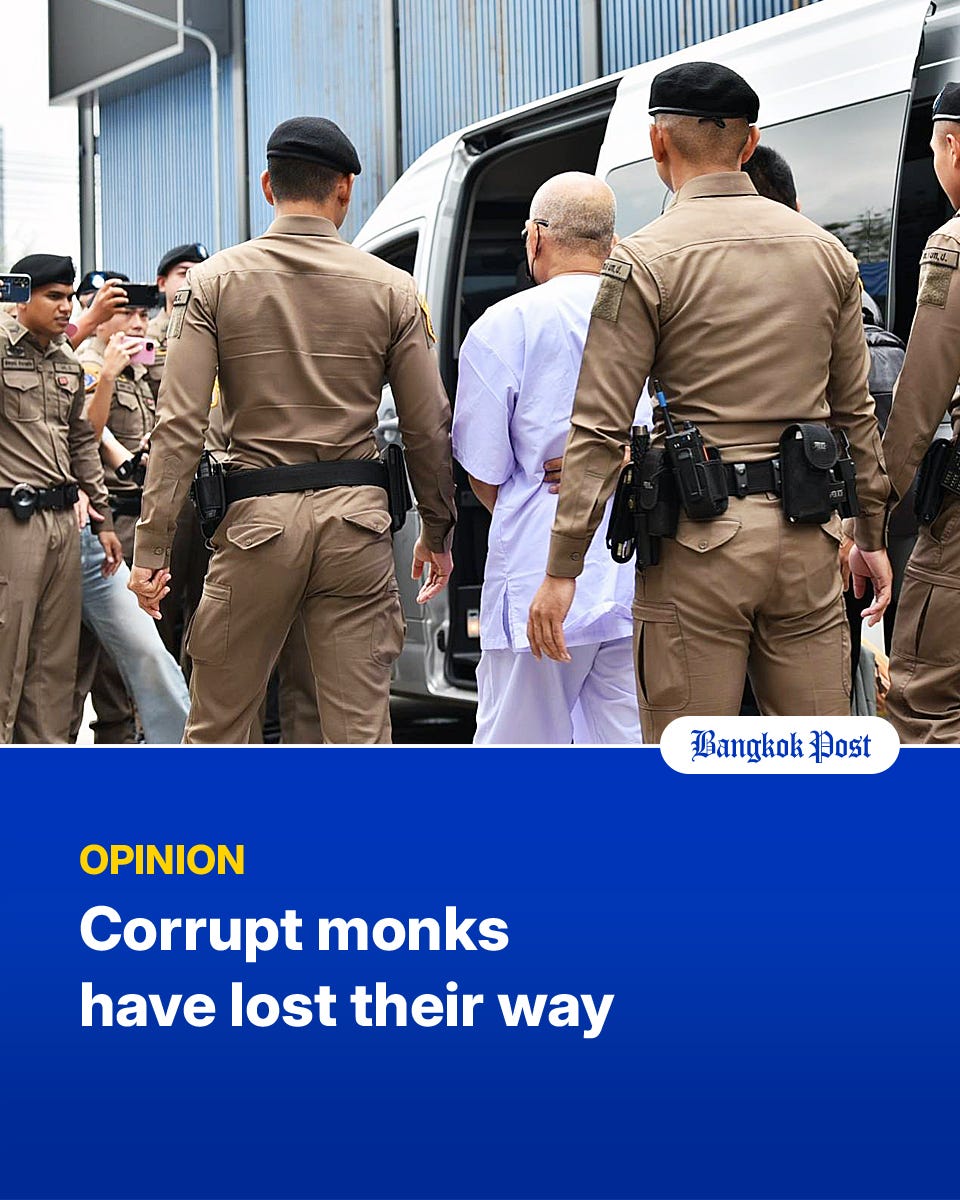
Even if the donation is karmically positive, the benefit may not necessarily outweigh the karmic debt incurred.
If a person ruins a thousand lives in order to earn 1,000,000 dollars, then makes a ‘generous’ donation of 10,000 dollars, is his karmic debt significantly mitigated?
If the 10,000 dollars were somehow perfectly donated to benefit a thousand lives’ worth of karma, perhaps. But most likely, the 10,000 dollars cannot even make up for the ruin of one life, much less a thousand.
“During the Great Depression, Al Capone opened a free soup kitchen at 935 South State Street in Chicago to feed the city’s soaring number of unemployed. Serving three meals a day with a “no-questions-asked” policy, the facility fed roughly 2,200 people daily and reached a peak of 5,000 on Thanksgiving in 1930. The kitchen provided a rare safety net for the hungry before widespread government relief existed, earning Capone a brief reputation as a modern-day Robin Hood.
Despite its charitable appearance, the operation was a calculated PR strategy designed to distract the public from the violence of the St. Valentine’s Day Massacre. Furthermore, Capone didn’t always pay for the supplies; he often used extortion and muscle to force local bakeries and grocers into “donating” food. The kitchen ultimately closed in 1932 after Capone was convicted of tax evasion, and the site has since been converted into a parking lot.”
Regardless of Al Capone’s true intentions, his good actions did karmically benefit a lot of people. It might have brought him a brief reprieve from the immediate consequences of his karma by paying off its interest, yet it eventually caught up.
人在做,天在看 (Man is doing, Heaven is watching)
Even worse is if one donates money to bad people.
Being ‘helpful’ is not necessarily good karma. Should you help Hitler? If one helped Hitler in his conquest of Europe, they would have a hand in a lot of suffering. But if they were helpful in the sense of dissuading Hitler from his worst impulses, that would certainly be a positive contribution.
The same goes for helping everyone you see. First, do no harm. Helping the wrong person harms more people. Helping the wrong way is like giving the wrong medicine. One must be wise in their perception and action. Yin and Yang, passivity and activity, surrender and struggle, must be balanced according to the needs of the situation.
In Singapore, human rights activists (often from or influenced by the West) protest the death penalty of drug traffickers. To them, the death penalty is inhumane especially since the traffickers are usually poor, desperate, pitiful. They only focus on one pixel of Reality and don’t see the bigger picture.
What about the lives ruined by drugs? One drug trafficker can easily bring in enough drugs to ruin a hundred lives. What is the appropriate punishment for causing death through overdose?
What if the death penalty were to be abolished? Would drug trafficking go down, stay the same, or increase given that the penalties are now lighter?
How many lives have been ruined due to the merciful treatment of drug traffickers?
So its extremely necessary to be discerning of the ‘good’ that one believes they are doing. Which is where Wisdom comes in.
Many parents claim they have good intentions when they use violence to discipline their children. And perhaps, mixed within the violence is indeed good intentions based on what they believe to be good for the child.
After all, parents usually come from a more traumatic background - the further you go back in history, the more traumatic life is. From their perspective, hardness and harshness may genuinely be understood to be ‘good’ for the children.

But again, the road to hell is paved with good intentions. It matters much less one’s intentions, and much more the actual karmic effect it produces.
Reality is often much simpler. Many who claim good intentions do not actually possess it. Some may indeed consciously think of themselves as ‘good’, but the trauma of their psyche has already distorted their ideas of ‘good’. Many forms of trauma were, in the past, completely normalised.
“Yes, child physical and sexual abuse were significantly more normalised in the past, largely because they were viewed as private family matters rather than social or criminal problems.
Physical Abuse: For centuries, physical violence against children was legally justified and culturally prescribed as “discipline” or “correction”. It wasn’t until the 1960s and 70s that medical professionals and social movements successfully labeled it a “social problem” through concepts like “Battered Child Syndrome“.
Sexual Abuse: Awareness of sexual abuse has historically occurred in cycles, often being suppressed by psychological theories (like early Freudianism) or social backlash. Before the 20th century, it was frequently dismissed or attributed only to the “lower classes”.
Legal Invisibility: Early child protection often relied on laws for the prevention of cruelty to animals because specific child protection statutes did not exist until the late 19th century.
Changing Standards: Many behaviours considered “normal” 60 years ago—such as severe corporal punishment in schools or extreme verbal shaming—are now classified as abuse or neglect under modern standards.
While reporting has increased due to better legislation and awareness, many studies suggest a true decline in the actual incidence of physical and sexual abuse in recent decades, likely due to proactive prevention efforts and shifting cultural norms.”
The definitions of good and bad may change, yet the karmic fruit remains the same.
So if good and bad are difficult for the conscious mind to differentiate (since empirical ‘norms’ are ever-changing), how does one do ‘good’?
The Golden Rule of Jesus comes to mind.
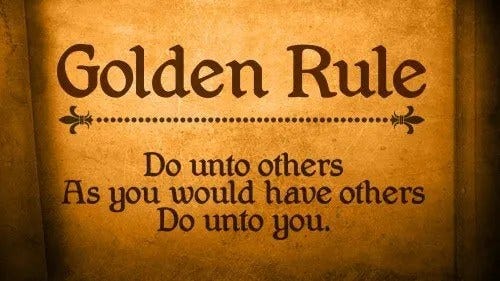
If a parent beats their child ‘for their own good’, they should not be surprised when the child returns the favor.
There may be occasions where one’s wisdom is underdeveloped relative to their Love. They may indeed want to do good, but are simply unsure how. A parent that sees their child 'drifting’ through life may not know if discipline and direction is what is helpful, or if support and acceptance is what is needed. In the West, the balance has sometimes tilted towards excessive unconditional support of a child’s actions which results in an overinflated sense of entitlement and self-importance.
(Actually, the parent is often as lost, if not moreso than the child. The highest path is the path of self-cultivation. When one is coherent, the world follows suit.)
What is crucial is to develop the sense of felt-coherence.
The empirical mind can only operate on the gross objects it perceives.
The conscious mind can only register inputs it is conscious of.
The rational mind operates on discrete logical patterns, tokens, symbols.
These can only describe an infinitesimal slice of Reality. Most of Reality is non-discrete, registering outside our conscious mind, beyond our empirical senses.
Intuition and feeling taps into a much deeper and richer reality. The more coherent and refined a person, the more powerful their intelligence becomes.
What is most helpful? As one develops their felt-coherence, the answers emerge clearly and cleanly.

To refine this understanding;
Your karmic reward is what your action produces, not the action itself. Donating large sum of money is much less important than donating money that helps the most people. Donating money to a bad person ends up harming more people than if you simply donated nothing.
Because the West’s notion of ‘doing good’ is much less concerned with reward, their good intentions are often purer and less distorted. Their virtue is not confused with reward.
Why are many in the West, even atheists, with no concept of karma still capable of charity and good?
Because for most people, when they do something bad, they feel bad. Even if it appears that one can ‘get away with it’, many decent people feel good when they do good and feel bad when they do bad.
This is their inner felt-coherence at work, the spontaneous sense of karma.
But there are those whose psyche is so fragmented and brutalised that the destructive tensions of their trauma override their sense of felt-coherence.
Greed, ambition, rage; abstraction, rationalisation, intellectualisation. The overwhelming chaos of emotion; the freezing isolation of the mind - all of it shatters the subtle sense of one’s coherence.
Karmic cycles
Abraham Lincoln and the Booth family
“The “karmic” relationship between Abraham Lincoln and the Booth family is often defined by a series of eerie coincidences and ironies that link the two families beyond the act of assassination.
Life-Saving Irony: In 1864, just months before the assassination, Edwin Booth (John Wilkes’ brother and a famous actor) saved the life of Robert Todd Lincoln, the President’s son. Robert had fallen onto a train track in New Jersey; Edwin pulled him to safety, unaware of his identity at the time.
Admiration vs. Hatred: Lincoln was a genuine fan of the Booth brothers’ acting. He saw John Wilkes Booth perform in The Marble Heart in 1863 and even invited him to the White House, though Booth refused the invitation due to his deep-seated hatred for the President.
The Spiritual Connection: Both families were deeply involved in spiritualism. Mary Todd Lincoln and John Wilkes Booth even shared a friend, a medium named Charles J. Colchester, who reportedly warned Lincoln of danger based on tips he likely received while drinking with Booth.
Shared Spaces: Booth attended Lincoln’s second inauguration and was standing near enough to kill him that day, an opportunity he noted in his diary as an “excellent chance”.
Political Catalyst: The final “karmic” trigger for the assassination was a speech Lincoln gave on April 11, 1865, where he voiced support for Black suffrage. Booth, who was in the audience, declared, “That is the last speech he will ever make,” and carried out the murder three days later.
John Wilkes Booth’s “karmic” end was a direct inversion of his personal vision. He viewed himself as a heroic savior but died a vilified fugitive, ultimately damaging the very cause he aimed to protect.
1. Hero vs. Villain Perception
Intent: Booth saw himself as a “new Brutus”, striking down an American Julius Caesar to save the Republic. He famously shouted “Sic Semper Tyrannis” (Thus always to tyrants) to frame the murder as a noble act.
Reality: Instead of being hailed as a liberator, he was universally branded a coward and a “common cutthroat”. His act of shooting an unarmed man in the back of the head violated the period’s sense of honor and was condemned by both the North and the South.
"In the terrible deed he committed, he was actuated by no thought of monetary gain, but by a self-sacrificing, albeit wholly fanatical devotion to a cause he thought supreme."[169] Others have seen more selfish motives, such as shame, ambition, and sibling rivalry for achievement and fame.
The West’s Immigration Karma
“Yes, it is often noted that migrants arriving in Western countries today frequently originate from regions that were heavily impacted by the historical transatlantic slave trade and colonization, particularly West Africa and the Caribbean.
While the experiences of migrants today are vastly different from the horrific injustice of slavery, some analyses explore how historical events like the transatlantic slave trade and colonialism have created conditions that contribute to modern migration patterns.
Points often discussed in such analyses include:
Historical Economic Disparities: The legacy of the slave trade and colonial exploitation is seen by some as having created lasting economic disadvantages and instability in regions that were heavily impacted. Contemporary migration from these areas is sometimes viewed through the lens of individuals seeking better economic opportunities.
Established Connections: Migration flows are often influenced by historical ties between countries. For example, labor recruitment from former colonies to Western nations after significant historical events helped establish networks that continue to play a role in current migration from those regions.”
Many refugees and migrants come from regions that the West directly destabilised - Africa, South America, Afghanistan, the Middle East

In 2012, 73-year-old Carl Ericsson of Watertown, South Dakota, was sentenced to life in prison for the murder of his former high school classmate, Norman Johnson.
Here are the key details of the case:
The Grudge: The motive stemmed from a 1950s high school locker room incident where Johnson, a popular athlete, humiliated Ericsson, a student manager, by pulling a jockstrap over his head.
The Incident: In January 2012, nearly 55 years after the incident, a 73-year-old Ericsson drove to Johnson’s home and shot him twice in the face when he answered the door.
The Sentence: Ericsson pleaded guilty but mentally ill to second-degree murder and was sentenced to life in prison without parole.
Investigation: Prosecutors indicated that the resentment had been held for decades, worsened by jealousy over Johnson’s successful life as a teacher and coach.
The case is frequently cited as an extreme example of a lifelong grudge and the psychological danger of harboring resentment over many years.
We see karmic cycles playing out everyday. Some are micro-cycles that complete in minutes, hours, days. Some are macro-cycles that span years, decades, lifetimes. They involve individuals, families, nations. The Israel-Palestine conflict is one of neighbours stuck in a karmic cycle of mutual destruction.
One may slip the hands of justice but not the reach of Heaven. When I examine evil historical figures that escaped human justice, none have happy ever afters. They suffer from poor health, an absent or destroyed family, are despised social pariahs, and are full of pains and regrets.
“In the classic Chinese novel Journey to the West, the “Buddha Palm” refers to a famous wager where the Buddha challenges the arrogant Monkey King (Sun Wukong) to leap out of his palm. Wukong, who can cover over 55,000 km in a single somersault, smugly agrees, believing the Buddha’s small hand to be no match for his speed.
However, despite flying to what he believed was the edge of the universe (marked by five pillars), he was shocked to find that he had never left the Buddha’s hand; the five pillars were actually the Buddha’s fingers. The Buddha then flipped his hand, transforming it into a mountain that trapped the Monkey King for 500 years as punishment. This story illustrates that the Buddha’s palm represents the entirety of the universe, from which escape is impossible”
Karma and New Age Thought
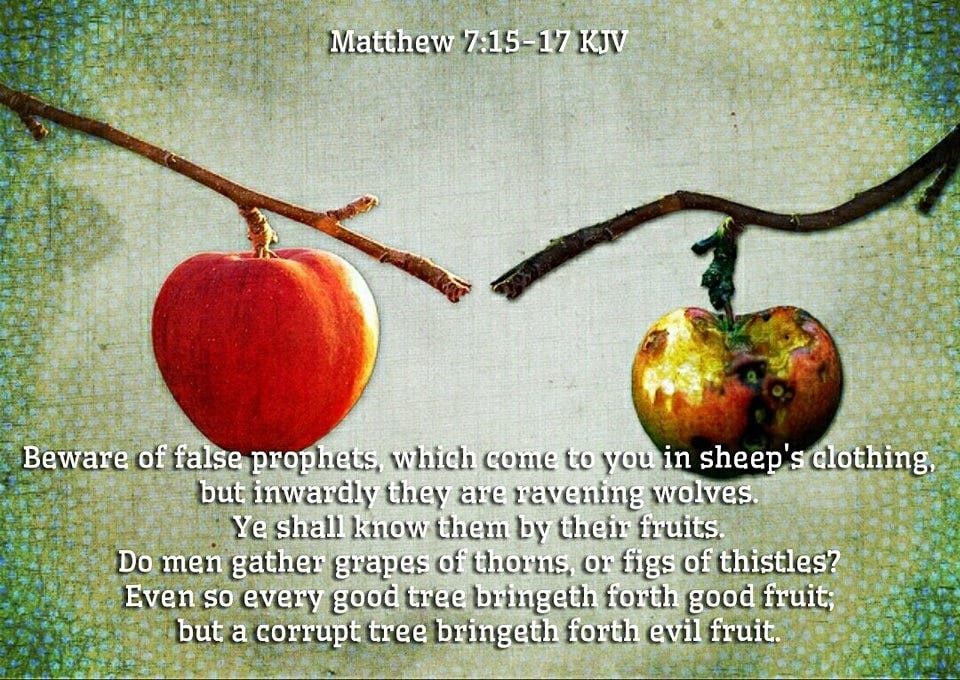
“The Law of Attraction (LOA) is a New Thought, spiritual belief that positive or negative thoughts bring corresponding experiences into a person’s life, operating on the principle that “like attracts like”. It suggests that thoughts are pure energy, and by focusing on desired outcomes with visualization and positive emotions, individuals can manifest health, wealth, and relationships.
Key aspects of the Law of Attraction include:
Fundamental Principle: The core idea is that people attract what they focus on, as thoughts are believed to influence reality.
Core Components: It involves using creative visualization, affirmations, and cognitive reframing to replace negative, limiting beliefs with empowering ones.”
I had an intuitive sense that there was some truth behind this, but I just couldn’t get it to work.
There were remarkable instances of it half-working that kept my curiosity and interest - I just couldn’t get it to work goddamnit.
I could see that positive and confident people did ‘manifest’ external realities that reflected their inner state. And how negativity resulted in self-sabotaging-reinforcing cycles.
The stumbling block was that I couldn’t figure out how to change the inner state. Just ‘thinking’ or ‘assuming’ positively did not work. The effort of the conscious mind was like splashing on the surface, unable to penetrate the depths of consciousness. I could change the coat of paint but not the substance.
Spiritual practice was the most direct and practical method that did work, albeit slowly.
Through my spiritual practice, whilst I didn’t try to ‘manifest’ a particular state, it gradually harmonised my psyche and siphoned off my inner tension and in doing so, made me feel more coherent and at ease. I didn’t try to become more confident but I did become more confident.
On hindsight, I now realise that trying to ‘be confident/ positive’ through conscious effort without dissolving the psychic tensions beneath is futile.
Confidence and positivity are downstream effects of a coherent and harmonious inner state. When one’s self is absent of inner tension, the resulting coherency and sense of well-being is what reflects as confidence, abundance, positivity.
And when I came across the idea of releasing body tension, it immediately struck me that this was the ‘missing key’. Because no matter much inner work was done, as long as the body held onto tension, the mind could not be completely relaxed, at ease.
Or perhaps this was an ‘expansion’ of the inner work. Because ‘inner work’ subtly dissociates the body from consciousness, as if the body was not part of the self. That dissociation itself was a tension of consciousness, an imposed separation between body and mind.
So the release of body tension ‘unlocked’ even more coherence, clarity, energy, well-being.
I had been gradually feeling the ‘pull’ towards creation and activity, and I finally let it express itself by exploring and developing the tension-charge model.
Perhaps ‘external’ activity outside of the body was another definition of dissociation. Subtly, I had divided inner and outer by separating the body and outside the body. I had determined to myself that happiness and satisfaction were inner states independent of the external world.
But what if the separation of inner state and outer world was itself a mental tension?
Allowing myself to act and express externally released another source of tension. In the process of writing, I gained even more clarity and coherency as to what was going on, happening, in myself, the world, reality.
Previously, I had dissociated from my inner self by focusing on the external world. Then I swung the other way, dissociating from the external world to focus on the inner self. This was a logical foundational step, since the inner self is closer, deeper, more fundamental. But only when I recovered and bridged my dissociated-parts did coherency and clarity really emerge.
Now it dawns on me
积德福报 is merely the outer logic of the Law of Attraction.
The karma you create in the world, in turn visits upon you.
Like attracts Like.
A positive inner self leads to positive actions leads to positive karmic reward
天地人和 (Tian Di Ren He)
Heaven, Earth and Man in harmony.
Did life improve because of my inner state? Or because I created good karma? What was the karma before the karma, the seed before the seed?
Which came first, heads or tails?
The dreamer or the dream?
The reader or the writer?
You or Me?
Perhaps this is why Chinese metaphysics and spiritual cultivation has two approaches; inner cultivation and virtue-accumulation.
They both lead to the same thing because they are the same thing. They look distinct only because one is heads and the other is tails.
When you finally see and treat the world as your self, so does the world.
This post focuses more on (external) virtue-accumulation, but the ultimate goal is to become the embodiment of virtue, so that every action is itself an act of virtue. All of my blog posts are in fact some way related to the embodiment of virtue/ enlightenment.
人在做,天在看
(Man is doing, Heaven is watching)
人算不如天算
(Man proposes, Heaven disposes)
So what I am encouraging is that the reader experiment with this worldview of 积德福报 - that your fortune follows from your virtue.
Act to accumulate virtue and do Good instead of aiming to accumulate wealth.
Focus on 积德, not 福报.
When interacting with people, be more patient, gentle, understanding.
Whatever harms or misdeeds you excuse yourself for doing - “he deserved it”, “he made me do it”, “i had no choice”- no excuse, just don’t do it.
Be more magnanimous and generous. Allow for minor injustices, differences, disagreements.
You don’t need to get even, Heaven will even things out for you.
That inner push to do Good…push it all the way.
An interesting pattern I observed in my life is that when i tried to ‘earn’ money, it was often a struggle. When I stopped trying, money often came in effortless and unexpected ways. The 积德福报 understanding is that since my virtue was of a certain level, trying to acquire more money than I karmically deserved required tremendous effort or sacrifice. But from the other perspective, I didn’t need to do much or anything to ‘earn’ money - it naturally flowed in and topped itself up to whatever I deserved.
The wealth of Water is constantly flowing - but we are only allowed to accumulate as much as our karmic container allows.
When I ask my host if he feels he needs any more money he is completely matter of fact — without a hint of greed or self-doubt: “It’s not that I want more; but I will get more.
Since I didn’t want to ‘work’, my karmic container was relatively small - but I didn’t mind it. I was naturally frugal - but I probably could have been much less so since money would have just flowed back to the level I deserved.
I was always very careful and particular on not taking advantage of people. If people bought food or drinks, I would offer to pay my share - but they always rejected it. This became so common and routine that whenever I offered to pay, I could already anticipate that they would reject my offer.
When I paid for a service, I would often give extra if I thought it appropriate and deserving. And I found on many occasions that I was glad that I had done so, because when I needed to follow up on an issue, it was easy for me to do so because I had built up goodwill through my generosity.
For instance, a plumber came to install a water-heater in my house, and I appreciated the effort and work he put into it. So when it came to pay him 500 dollars, I paid him 550 dollars instead. Later that night, a separate-but-related issue came up. Because the water-heater had been damaged for a while, we had stopped using a separate tap in the bathroom and didn’t notice that the rubber seal had eroded. When the new water-heater was installed, I started using the separate tap and noticed it was leaking. So the issue had nothing to do with the plumber’s installation of the water-heater and it wasn’t his responsibility to fix it. Nevertheless, I asked him if he could drop by.
The next day, he quickly fixed it and when I offered to pay him another 50 dollars for the service, he rejected it.
The same with courtesies and thanking people. Even though most of my courtesies had no direct and immediate ‘reward’, on the occasion that I needed follow-up or additional help, the other party was willing because I had built-up goodwill.
One time, the football group had booked a court but as there were not enough players, the game had to be cancelled. But the court fees still had to be paid. I transferred a significant part of the fees to cover the sum but the organiser said that they would just rollover the fees to the next week. So they thanked me and refunded me.
Another time, I lost a football. A few weeks later, a football appeared on top of the soccer cage netting - someone had likely kicked it there and it was extremely tricky to retrieve.
Since the football had some weight, it gravitated towards the center and would roll back there even if we managed to push it around a bit. We tried for a few minutes to retrieve it (by kicking a ball at it from below the netting), but it needed to be hit with enough force at the correct angle to push it off all the way We gave up after a while and continued with the game but afterwards, one of the players tried and miraculously succeeded on the first two tries.
In the news, there are often stories of people caught scamming, stealing, under-reporting their taxes, etc. Many instances of people trying to grab more wealth than they deserve end up repaying the karmic debt with interest. Sometimes, karmic repayment comes through human laws, but very often, they come through other means. Conflicts, ‘accidents’, disease, etc are all ways in which one’s debt can be repaid. In the criminal world, whilst the law may sometimes intervene, we can imagine how most of the karmic debt is in fact paid by criminals turning on each other. When criminals appear to have gotten away, we assume that they have escaped justice but in all likelihood, it was meted out of the public eye.
福报 teaches that there is no need for one to get back against those who mistreated you. If you don’t do it, Heaven will do it. If you do it, then Heaven doesn’t need to do it. But in your attempts to get even, you may incur further karmic debt and entanglement. By harming you, he absorbed your karmic debt. By taking revenge, you create a new one you have to repay. Perhaps he had harmed you because you had harmed him in a previous life. The debts would have been settled had you just let it go, but by insisting on revenge, the cycle of karmic vengeance and suffering continues.
If one believes that Man is Doing, Heaven is Watching, Man proposes, Heaven disposes, then rest assured that whatever is theirs will be given to you, and whatever is not will be taken away.
Earlier in my life, I used to get entangled in conflicts and arguments. Some perceived unfairness, injustice, grievance, would stick in my mind, stick in my consciousness, and I would entangle my energy to ‘sort it out’, ‘get even’, or ‘get back’. I don’t think there was ever once a satisfactory ending. Even when I ‘won’, the victory felt hollow.
Eventually, I learned to disentangle. Some battles are not meant to be won. Most battles are not even meant to be fought. They only occurred because my 德 was too low. My psyche weak, hurt, compensating, insecure, divided - therefore it kept fighting to protect a self-defined victim. As inner clarity and coherence increased, I realised it was hurt people that hurt people and their unhappy inner state was punishment itself.
When my Dad lost money to the investment scam, he had actually ‘invested’ 20 000 that he was supposed to return to me as I had helped him pay his businesses expenses (because he had thrown everything in at that point). Given his state of stress, I decided to forget about the money and assumed that he would forget about it too. But a few months later, my Dad paid me a portion and said he would later return me the rest. I didn’t press him for it and I also didn’t keep track of what was ‘owed’, and when he repaid me the rest, I didn’t know how much had been repaid.
you think there are a million problems but you wake up from the dream and you realise there is just one - you, making up the million problems.
This blog as 积德福报
As my spiritual practice yielded positive karma, my life incrementally got better. I moved to a new, more comfortable house (with no effort of my own - my mom decided to buy one and was planning to rent it, but things didn’t work out and me and my sister ended up moving in with her). I upgraded from a laptop to a desktop, then to a better one - from a HDD to an SSD, from a small laptop monitor to a big desktop-monitor. My thinking became deeper, denser, clearer and my gaming ability became even stronger. I ‘upgraded’ my football group through a serendipitous sequence of events. My Dad needed me to help him with some work-stuff - and in the first few years, I found the work tedious, stressful and troublesome - but over time, it became much smoother. I used to go down to the supermarket to buy and carry lots of groceries - now we just have it delivered. I became better at cutting my own hair (I bought a hair trimmer), I put on muscle, my appearance improved, etc.
I didn’t have a lot more material wealth, but my life improved significantly.
But when I started this blog, the changes in life-improvement skyrocketed. Improvements that previously took years, now happen in weeks or months.
I can foresee that I am likely going to make a decent income from the stock market. I can just tell that I understand the logic and dynamics of it much better than I used to. The stock market and the economy is a macrocosm of the human psyche and quite fascinatingly follows Bazi patterns based on what I’ve observed. Previously my focus was entirely introspective - thus when I first started out investing, my ‘worldly’ knowledge was extremely simplistic. But as I gradually reconnect, I now see patterns I was previously oblivious to.
For me, its very clear that the 积德福报 I accrue is maximised by maximising the ‘reach’ of this blog and implementing paywalls would be setting fire to my own fortune. The more people I help, the more I am karmically rewarded. I can try to convert the 福报 into material wealth, but that would be exchanging currency at an extremely unfavorable rate. I suspect that many sales and marketing tricks and techniques are very Western-flavored - short-termist, symptom-based, temporary. You get a quick drug high that you have to keep maintaining and sacrificing and the moment the gravy stops, the cookie crumbles. In the long term, whatever your reach and influence comes from what you karmically put out and not the the tricks you use to juice the system.
Bing-Wu Year
In my previous post, I discussed the possible meaning and significance of the Bing-Wu year in 2026. I speculated that it was going to be an extremely volatile, transformative year.
Since that post, there has been a dramatic flood of events exactly as I speculated as we enter Bing-Wu on Feb 4.
I read that some schools of Bazi trace the start of the new year to the Winter Solstice, and in accordance with that view, we are already one month in it. But regardless of the exact timing, energy patterns don’t cycle through in distinct and discrete phases. As Bing-Wu draws close, its energy already starts to mix in.
How this manifests for me, personally, is that in the last month;
I began having more comments and interactions on my blog,
I felt the urge to (and did) re-enter the stock market - an extreme infusion of Fire-activity
I began having more interactions with the world - old friends, new groups, new people. I joined an alumni entrepreneurship-finance whatsapp group - which is super Fire-themed - old alumni-connections + entrepreneurship + finance.
Intense amount of personal transformation.
As for ‘the world’;
As I speculated, the USA will see more civil tensions - and the ICE (ironic name) shootings in Minnesota have triggered a very volatile and viral escalation of tensions.
“Winter Storm Fern (January 2026) was a “once-in-a-generation” event defined by its massive scale and lethal intensity:
Historic Reach: It impacted 230 million people across a 2,300-mile path from Mexico to Maine.
Record Extremes: Dropped up to 31 inches of snow and triggered a polar vortex that sent temperatures plunging to -43°F.
Human Toll: At least 106 deaths were reported, making it the deadliest winter event since 2021.
Total Gridlock: Caused 11,000+ flight cancellations in a single day and left over 1 million people without power.
Economic Shock: Cost an estimated $115 billion in damages and triggered a 28% spike in natural gas prices.”
In January 2026, Chen Zhi, the billionaire chairman of Prince Holding Group, was captured in a high-stakes international operation:
The Arrest: On 6 January, he was apprehended in Cambodia alongside two associates following a joint investigation between Cambodian and Chinese authorities.
The Extradition: Within 48 hours, he was extradited to China. State media (CCTV) broadcast footage of a hooded and handcuffed Chen being led off a plane in Beijing by SWAT teams.
Legal Collapse: Just before his capture, the Cambodian government revoked his citizenship, stripping him of political protection.
The Charges: He is currently detained in China as the alleged mastermind of a transnational criminal syndicate involved in massive illegal gambling and “pig-butchering” scam compounds.
Global Seizures: His arrest coincided with the National Bank of Cambodia liquidating Prince Bank and the U.S. seizing $15 billion in linked Bitcoin.
In late January 2026,Australiais facing its most severe heatwave since the 2019-20 “Black Summer,” with temperatures nearing 50°C.
Record Breaking: Victoria hit a new state record of 48.9°C (Hopetoun/Walpeup), while Renmark in South Australia reached 49.6°C.
Widespread & Persistent: Heat of 40°C+ has covered vast areas of VIC, NSW, and SA, with some inland regions enduring their longest stretch of extreme heat in nearly a century.
Major Impact:
Fire: A “state of disaster” was declared in Victoria as out-of-control bushfires destroyed over 900 buildings.
Health: Melbourne hospitals saw a 25% surge in emergency admissions.
Infrastructure: Thousands have suffered power outages due to grid stress.
Release of Epstein files. This is so huge, and its fortunate that I took my time to publish this, as the Epstein files really signals the themes of Bing (the Sun, bringing to light and exposing everything), and Wu (The horse, driving change and momentum)
Gold-Silver Volatility. Fire Melts Metal. Cryptocurrency is also a form of Metal.
As of February 1, 2026, gold and silver prices are undergoing a historic correction following a record-breaking rally in late January. After peaking at all-time highs of approximately $5,600 for gold and over $120 for silver on January 29, both metals experienced their steepest single-day declines in decades on January 30. Gold fell roughly 11% to settle near $4,880–$4,900 an ounce, while silver plummeted nearly 30%, ending the week at about $85 an ounce. Market analysts note that both metals still maintain significant year-to-date gains, with gold up roughly 17% and silver up nearly 40% in January alone.
Given that both Gold and Silver are still up by a lot, this is no indication that the prices of these metals will crash or collapse. Only that the volatility of Metals fulfils the themes of Bing-Wu.Given how stunningly world events have mirrored the themes of Bing-Wu, I now feel confident to speculate that Earth will gain tremendous value, since Fire produces Earth. This mean rare earths, land, property, real estate will significantly appreciate. This is not investment advice, since you get what you deserve.
Note that these events all appeared and broke suddenly and dramatically into public visibility.
In the last few days, I suddenly “ran into” two scams - which I found to be quite extraordinary. Usually, I am ‘scam-proof’ - I usually pick up on nefarious motives very quickly. I might be susceptible to impulse and impatience, but not to greed or desperation which is what most scams prey on.
The first ‘scam’ was a phishing attempt. One of my old school friend on facebook messaged me with a link to vote for him. I recalled that he was involved in music so I didn’t think much about it and clicked the link to vote for him. It brought me to a page where I was supposed to login to my facebook or instagram to vote. So I entered in my email and password without much thought.
( I did a quick google search and he is indeed a musician)
Now the funny thing is that I previously had trouble with remembering my correct passwords because it had been compromised many times throughout the years. So when I was prompted to change my passwords, I made very simple changes I didn’t really note down. I didn’t really care about making my passwords absolutely secure because I just didn’t feel like it.
So when I entered my email and password, the form refreshed and the error message of ‘incorrect password’ appeared. I think this was intended to get people to try to then also login to the other account.
But in my case, I really thought (and it was likely) that I had entered the wrong password. So i tried various configurations and the same error message kept appearing. I decided to forget about it…but a minute later, I suddenly got suspicious. I realised it could be a phishing attempt, so I went ahead to change my password


A few minutes later, I received the above notifications. LMFAO
Soon after, I received a facebook message
The next scam happened a few days later
After I added the person on whatsapp (i deleted the chat and couldn’t recover it), i said ‘hi’, waited for a few seconds, then went away.
When I looked back an hour later, the person had replied ‘hey you’re welcome. how can I help you.’ Like wtf?
So I responded that he had approached me to add him on whatsapp so I did.
Then the person goes ‘I have a life-changing investment opportunity…’.
Damn, he didn’t even take me out to dinner first.
I went back to the comment and realised that it was an impersonator and just reported, blocked, deleted, and moved on.
Previous phishing attempts were typically through emails or random ‘women’ adding me on Facebook. These two attempts seemed relatively ‘innocent’. Given my Fire-dominant Bazi, I have a natural impulsiveness, impatience, and friendliness. So I didn’t really hesitate and just ran into the fire.
For those who are blessed, they run into fire but don’t get burned. The scammers tried to get me but I burned them instead. The phishing links, profiles, etc have all been removed and suspended the last I checked.
With reference to Chen Zhi and the Ming family being arrested and sentenced…this is an illuminating example of the energy of Bing-Wu.
Fire. Visibility. Transformation.
Those who have been hiding will be exposed.
Those who are deserving will be razed to the ground.
Exposed. Arrested. Executed.
The sudden frequency of the scam attempts caught me by surprise. But they perfectly capture the double-edged nature of Bing-Wu.
If one has sufficient 德, they may get briefly pulled in yet emerge unscathed. Why are some susceptible and fall prey whilst others are immune?
积德福报 diff.
I wasn’t tempted by the lure of life-changing wealth due to my conviction in 积德福报. So when the offer was dangled, I just sussed it out immediately.
But to a person with a poorer 德? The prevalence of scams and ‘opportunities’ will rapidly ensnare them.
This is the nature of Bing-Wu. More opportunities. More temptations. More dangers. The promise of dramatic transformation is a merciless fire.
I can already see scammers using AI to intensify their operations. These scammers might be criminal and they might also be legal. The promise of big, fast, easy money will consume a lot of fortunes. And plenty of scammers will find the Cosmic Sun shining upon them to mete out Divine Judgement.
Which is why 积德福报 will be more essential than ever.
Karmic cycles will magnify, accelerate, and complete far more dramatically.
As I was building upon this post, I came across Western astrology discussions of 2026
“In 2026, the Saturn-Neptune Conjunction (February 20) marks a “Global Hard Reset” at 0° Aries, the first degree of the zodiac. It blends Saturn’s structure with Neptune’s dreams, signaling a time to turn idealistic visions into tangible reality while dissolving outdated systems.
Uranus in Gemini (2026–2033)
Uranus enters Gemini on April 25, 2026, and remains there until 2033.
Themes: This transit revolutionizes communication, information technology, and travel. It favors decentralized networks, leading to advancements in AI and digital literacy.
Energy: It is fast, unpredictable and rewards mental flexibility, but can be overwhelming.
Impact on Gemini (The Sign)
For those born under the sign of Gemini, 2026 is a year of personal reinvention and liberation.
Authenticity: Uranus transiting Gemini encourages breaking from old identities and embracing individuality.
Relationships: Magnetic energy peaks around April 24, 2026 (Venus conjunct Uranus), potentially sparking unconventional romances or social connections.
Career & Growth: Expect a shift towards autonomous or tech-related work. Success comes from consistency and discipline.
Focus: The 11th house is also activated, suggesting a role in building visionary or spiritual communities”
Its really fucking crazy huh? How Chinese Bazi, Western astrology, celestial motions and my personal narrative weaves across the threads of space and time.
In case the reader is unaware, I am a Gemini Sun. I also predicted in my previous post that myself and this blog would feed off the fire of AI and Bing-Wu to dramatically transform this year.
“While Saturn and Neptune conjunct approximately every 36 years, their meeting at exactly 0° Aries is a “Genesis moment” that hasn’t happened in thousands of years.
Last exact match at 0° Aries: Most astrological sources, including Astro Butterfly, believe this hasn’t occurred for over 9,000 years, dating back to approximately 7,000 BC.
Historical “Near Misses” in Aries:
593–594 BC: A conjunction occurred at 2° Aries. This era is noted for the start of the Axial Age, which saw the birth of major philosophical and religious movements like Buddhism and Greek philosophy.
1703: A conjunction occurred at 11° Aries. This coincided with the War of the Spanish Succession and the founding of St. Petersburg.
Significance of 0°: Because 0° Aries is the “World Point” or the very start of the zodiac, this 2026 alignment is considered a far more powerful “hard reset” than previous conjunctions in other parts of the sign.
Yes, many astrologers link this rare alignment to the dawn of the Neolithic Revolution (the birth of agriculture and settled life).
Historical Parallel: The last time Saturn and Neptune conjuncted at 0° Aries was approximately 7,000 BC. This period coincides with humans transitioning from nomadic hunter-gatherers to settled farmers who “designed” their environment.
Symbolic Meaning:
Saturn represents structure, rules, and physical foundations.
Neptune represents the dissolution of the old and the emergence of new, collective visions.
The Transition: In 7,000 BC, this manifested as humans building “durable structures” (Saturn) in response to radical climate shifts, effectively setting the foundations for modern civilization.
The 2026 Connection: Because it is occurring at the same “Genesis point” (0° Aries) for the first time in roughly 9,000 years, it is viewed as a similarly massive civilizational reset. Just as agriculture fundamentally changed how humanity survived, the 2026 alignment is expected to usher in a new era of “manifested visions,” possibly through breakthroughs in AI, decentralized systems, or spiritual restructuring.”
https://en.wikipedia.org/wiki/Bill_Morgan_lottery_win
“As of late 2025, Bill Morgan—the Australian truck driver famous for winning the lottery twice after surviving a 14-minute “death”—remains in Melbourne with his wife, Lisa.
While he still lives in the house he purchased with his winnings, his life today reflects both his incredible luck and ongoing physical challenges:
Health: Now in his 60s, Morgan suffers from chronic heart issues and arthritis, which led to his early retirement. He describes his daily routine as a “shuffle down the road to smell the roses,” remaining grateful for the “bonus” decades he has lived.
Lottery Habits: He continues to buy a Tattslotto ticket and a $5 scratchie every week, though he has not had another significant win since the famous 1999 televised event.
Legacy: His story recently resurfaced and went viral again in late 2023 and 2024, leading to new interviews where he reflected on the “incredible time” of his wins and his enduring gratitude for his second chance at life.”